Wisdom

When asked as a child what superpower I would possess if I could pick any in the world, my response was always wisdom. While this doesn’t seem too imaginative or come across as a terribly fantastical response that you’d expect most children to provide to such a question, looking back it’s probably the most imaginative of all.

Growing up in a “Godly house”, my parents emphasized the role of the Bible as the leading narrative in our home. From an early age one particular story struck me so profoundly that it shaped me forever: the story of King Solomon (1 Kings 3-4; 2 Chronicles 1; Psalm 72). The parable involves two women arguing before the King in an effort to win ownership over a infant child. These women gave birth just days apart, but one woman rolled over on her child while sleeping and killed it, and now she was claiming that the other woman’s child was her own. King Solomon, being the wisest man who ever lived, listened to these women intently before he requested his sword. He reasoned, if both the women claim ownership over the baby, let them both have it: cut the baby in half!

At this the real mother fell before his feet and begged him to spare the child, to give her son to the other woman. The other woman was ambivalent, saying to cut the baby in half so that neither would have one.  At this Solomon stopped the baby’s execution and pointed at the first mother, saying “She is the real mother, give the baby to her.”

Though simple, this story struck me powerfully in my youth. What was most curious about the stories of Solomon was that because he requested wisdom and judgment over riches and power, he was rewarded with all of these and more! In my youth I reasoned that wisdom was the key to achieving all other desires. More fascinating is that the motivation for his request of wisdom sprung from his desire to be a servant, to serve god.   Being a servant requires humility, it requires that the subjective ego disappears in favor of another perspective, a more objective perspective devoid of bias or valuations or deires. This attitude of being a servant is necessary for learning more generally.

However, one must not stay a servant. Eventually, after accumulating enough knowledge and wisdom, one must become the leader, become the intrepid visionary who creates alternative realities for others to hope in; future worlds charged with the character of progress. George Bernard Shaw said it best: “The reasonable man adapts himself to the world, the unreasonable one persists in trying to adapt the world to himself; therefore, all progress depends upon the unreasonable man.” Be reasonable while you are learning, but tenacious and unrelentingly when enacting a vision. Being reasonable is a static state; being unreasonable is a fluid state. Adaptation requires the fluidity of change. The span of life is unreasonable and changing– only moments are reasonable, but there are far too many moments to reason.

Ironically, the downfall of Solomon was pleasure. It’s the same struggle told throughout history between mind and body. His lust for women, for pleasurable indulgence of the body, caused him to undermine his wisdom, his mind, and use poor judgment. This is a timeless parable between being caught up in the tangible short-lived things of the world and being obedient to the external qualities of mindful wisdom.

Now, I’m not a religious man. I consider myself very worldly, recalling the Socratic wisdom “I am not an Athenian or a Greek, I am a citizen of the world” and the quote by Thomas Paine “The world is my country, all mankind are my brethren, and to do good is my religion.” I believe in experience, not abstract symbolism and language with no immediate or demonstrable footing. I will not feign the metaphysical, the supernatural, the spiritual. There is one spirit, one universal consciousness that imbues all experience with meaning and power, and that is possessed by me alone. The Other minds aid as intermediaries in my journey, but no single Other nor text nor image nor experience will provide the answers I seek. It is the collective combination that yields wisdom; the synthesis of history with the present. And this task is reserved for me alone.

Psychiatric Evaluation Age 14
Psychiatric Evaluation Age 14: My sagacity quickly devolved quickly beyond number three.

The above screen shot is from a psychiatric evaluation conducted when I was 14. Though my fascination with wisdom began when I was much younger, it has persisted throughout my life, leading me to study philosophy (love of wisdom) and economics (law of the house).
Heteroglossia

Let us examine some fundamental bible verses in order to extricate some understanding from the text and decipher the meaning of the passage:

“The fear of the Lord is the beginning of wisdom, and knowledge of the Holy One is understanding” (Prov. 9:10)

In the Original Greek,

“archē sophias phobos kuriou kai boulē agiōn sunesis to gar gnōnai nomon dianoias estin agathēs” (Prov. 9:10)

Breaking down the words:

Archē (ἀρχή): a word with primary senses ‘beginning’, ‘origin’ or ‘first cause’ and ‘power’, ‘sovereignty’, ‘domination’ as extended meanings.

Sophias (Σοφíα): meaning “skill or cleverness in carpentry, music, or other crafts” or “skill related to everyday life: sound judgment, prudence” or “knowledge of a higher kind: learning, wisdom”

Phobos (Φόβος): meaning “fear”, phobos was also the Greek god of “horror” or “terror”

Kuriou (κῦρος)translated as Lord, meaning “supremacy” or “guardian” referring to the master of the household. A woman could not enter into any contract without her Kurio. In antiquity κύριος was translated as Kuros or Cyrus from Old Persian as a denoted male name or kingly title. Kyros is a Greek boy name derived from Κύρος, meaning of the name is ‘Far Sighted’.

Kai (καί): “and, even, also, both” or “actually, apparently, a primary particle, having a copulative and sometimes also a cumulative force”

Boulē (βουλή): meaning “will, determination, decision” or “plan, project, intention” or “counsel, advice, council, senate”. A political term meaning to will (after deliberating ) referred to a council of citizens (called βουλευταί transliterated as bouleutai) appointed to run daily affairs of the city. Originally a council of nobles advising a king.

Agiōn (άγιος): “holy, saint, pious” or “devoted to the gods”

Sunesis (σύνεσις): Meaning “a putting together in the mind”, hence: “understanding, practical discernment, intellect”. From the cognate sýnesis meaning “unification, meeting, sense, conscience, insight, realization, mind, reason”. This is where the Latin word synthesis is derived, meaning “collection, set, composition (of a medication),” from Gk. synthesis “composition,” from syntithenai “put together, combine,” from syn-“together” + tithenai “put, place,” from PIE root *dhe- “to put, to do”.

to gar: Meaning “for” or “after all”

Gnōnai (γνῶσις): meaning “know” from Proto-Indo-European *ǵenə-*ǵnō- “to know”. This is where the religious word “Gnostic” originates from Gk. Gnostikos, meaning the technique of knowing, or the ability to discern.

Nomon (ὄνομα): from L. nomen meaning “name” or “fame; to make a name for oneself” or “noun” or “phrase”.

Dianoias (διάνοια):  Meaning dia- “διά” + mind “νοια”, this word was used by Plato to describe a type of thinking, or intelligence, specifically about mathematical and technical subjects. It is the capacity for, process of, or result of discursive thinking, or dialectics. Dianoias literally means “between minds” and is intended to describe the relationship of thinking across two “minds” or ideas of thought. Whereas dianoias refers to “between minds”, dialects refers to “between speech” deriving its meaning from dia- “across, between” + legein “speak”. Because dianoias involved thinking about competing ideas, it contrasted with noesis– derived from nous (νοῦς) meaning “mind”– which was characterized by immediate apprehension, like thoughts and ideas or divine reason or practical wisdom, similar to our modern understanding of intelligence.

Estin (εστιν): the present active indicative third singular of εἰμί meaning “is he”. εἰμί means “I am”, derived from the Proto-Indo-European *h₁es- (“to be, exist”)

Agathē (ἀγαθός): Meaning “good, brave, noble, moral; fortunate, lucky; useful”. Coincidentally it is a female given name, which is reflective of ancient Greek attitude towards women as useful instruments of the household.

Some Thoughts

“archē sophias phobos kuriou kai boulē agiōn sunesis to gar gnōnai nomon dianoias estin agathēs” (Prov. 9:10)

My weak translation:
“The origin of wisdom is fear of his authority and will of pious understanding for knowing the name among minds is he good use.”

The Greek word θεός  (theos) with the Phyrigian cognate δεως (deōs) meaning God in English. This is also where the Latin word for god deus is derived. It is often connected with Greek “θέω” (theō), “run” and “θεωρέω” (theoreō), “to look at, to see, to observe”. The Proto-Indo-European translation of god is *ǵʰeu̯- meaning “invoke, pour.”

Hebrew: “תְּחִלַּ֣ת חָ֭כְמָה יִרְאַ֣ת יְהוָ֑ה וְדַ֖עַת קְדֹשִׁ֣ים בִּינָֽה׃ ”
The literal translation is “Understanding of the sacred and knowledge of God fear is the beginning of wisdom”

While the Hebrew translation is helpful, historical records provide little elaboration of the meaning of the terms being employed, such as understanding or sacred or knowledge or God. They simply seem to translate directly. However, while the original meaning of the word יְהוָ֑ה or Yaweh (God) is lost, contemporary scholars assume  יְהוָ֑ה or Yaweh to mean “He Brings Into Existence Whatever Exists” or “I am that I am”.  It leads me to believe that they were preoccupied with understanding the forces and materials of nature, i.e. physics or natural causation, and it was in this understanding and the mindful observation and awareness it requires that all life’s answers reside, much in the way science fulfills this duty today.

The Stoic Epictetus coined the term for soul as hēgemonikon meaning “ruling principle or reason” (or “governing principle”).

Happiness

Happiness consumes itself like a flame. It cannot burn for ever and the thought of its end destroys it at its very peak. -Strinberg

People who ruin themselves through their own stupidity always blame the one person they couldn’t fool. -Strinberg

They say happiness is only real when it’s shared. Well, in that case it would seem that relationships are the greatest source of happiness for people. And, in that case, it would seem that these people depend an awful lot on others.

That’s why I don’t like this rendition of happiness. Happiness, first of all, is illusory. It is a weird product of self-affirmation and the contentment afforded by the familiar, by the predictable or expected. And I believe that self-affirmation— contentment, that is— can be achieved in any state by any person if he is known to himself, that is, if he should believe himself to content.

Regarding relationships and sharing happiness, I believe this is a rosy picture that robs people of their individualism, their ability to remain self-affirming, self-sufficient, to remain known to themselves.

Legere: Gather and Bind

We are a collection of thoughts. The self is a recollection: a continual recollection.

The Latin word legere is based on the PIE *leg- “to pick together, gather, collect”. Lego (λέγω) in Greek means “to count, tell, say, speak”. It is the root for the Gk. words lexis (λέξις) and logos, where we get modern words lexicon and logic and the like. Lexis  means “speech, diction”, whereas Logos means “word, thought, idea, account, reason”. Originally used by Homer as “to pick out, select, collect, enumerate;” cf. Gk. legein translates as “to say, tell, speak, declare”. The word Lecture is based on L. legere which means “to pick out words”.

The word Religion is derived from the Latin words re- “again” + legere “read, collect, gather up, select” from which the word “lecture” is based. What I found interesting is that within the word religion I notice the root ligare or lego which means “tie, bind, unite” and the word “ligature” comes to mind which means “bind, connect”. In this way religion can be interpreted as a way of ensuring the repeated gathering and binding of text to the mind through reading or, alternatively, the reuniting or reconnecting of people.

This is also where the word Intelligence is derived, from the Latin words inter- “between” + legere “choose, pick out, read”. Translated literally, the word intelligence refers to the ability to “select among”. Upon further reading I discovered that the word Diligence in Latin originally meant “to pick out, select,” from dis- “apart” + legere “choose, gather”.

*

It is also where the word “liege” comes from, referring to a lord to whom his subjects or “liege men” were bound.  Additionally it is where the word Allegiance is derived (although this translation is disputed).

Worlds

I don’t know you, but I tell myself we have something in common: a taste for novelty, for variety, for something the jolts our senses, a visceral violation of our vallations.

Do you ever find yourself wondering?

I grew up believing that true happiness was found in meaningful relationships. I reasoned that our encounter with others provided an encounter with another world, full of alternative possibilities and imagination. But as I grew older I found myself more alone, more in the company of myself, and the world’s I encountered grew more colorful and intense and variegated; only these world’s were my worlds.

I embraced this development as a function of my supreme individualism and continue constructing these palaces and adorning them with the content made increasingly available to me


Thoughts: Developing a Culture for Exploitation

Unfinished thoughts

Throughout the course of my studies a pressing question has remained at the forefront of my mind: what accounts for the inequalities across the spectrum of humanity? This broad question entails every aspect of the human condition where disparity exists among men, from normative behaviors between cultures to local differences in educational attainment  among individuals and even differences in progress among civilizations across historical epochs.

What I have discovered is that institutions are the single greatest influence in dictating the success of individual’s and ultimately their society’s successful development. It is through institutions that social construction takes place, where the congenital organization of fundamental values and virtues form that intermediate our every response in thought and action.

Cause and effect is the fundamental relationship of all change, of all progress through time. Regarding society, man is the first cause. Life is the initial impetus that drives all proceeding effect. It is the life’s innate propensity for equilibrium that facilitates action. This propensity is dichotomized between proaction and reaction. Proaction is reflective, while reaction is absorptive. One is master, the other slave. The master embodies a will-to-power that dominates over oppression. The slave embodies a will-to-survive that acquiesces under oppression. One is possessed by self; one is possessed by other. One is prophet; one is priest.

Across every of civilization throughout recorded history there has been a distinctive governing feature permeating them all: language. Each culture took pains to preserve this language through an oral tradition preserved by groups of individuals within the community. In ancient Greece these groups were called cults and associated with upholding the specific oral tradition of a given Temple or god. These cults were comprised of individuals devoting an acute interest in performing duties as priests or prophets for the temple in order to conduct the custom and ritual to preserve the language and myth. In this way cults functioned to preserve the nomos or non-explicit “law” that accompanied all of the normal rules and forms people take for granted throughout their day to day activities.

The reason that cults served such an important function is due to the role that religion played in orchestrating the Greek conception of time. All festivals revolved around these temples.

Cultures of Economy (Economics from Gk. oikonomikos “practiced in the management of a household or family,” hence, “frugal, thrifty,)

What are these institutions you speak of? In 19th and 20th century economics Thorstein Veblen developed a new kind of economic theory dubbed Institutional Economics.

Concepts & Terminology:
Authority (Status; supremecy; preference; prestige)
Hierarchy (Ensures Efficient Transmission; channels)
Power (Ensures Effective Transmission; leverage)
Value (Semantics; Significance; guiding assumptions guiding priority)
Isomorphism (Truth; symbolic relation to truth) (Nietzsche; Rorty)
Utility
Language Games (No Private Language: beetle in a box)
Relationships or orientation
Dialectics (Subjective v Objective; Individual v Collective; Part v Whole; Soul v Body; Immaterial v Material; Population v Typological; Analytic v Empirical; Deductive v Inductive)
Repetition and Duplication (Derrida; Baudrillard)
Equilibrium Theory (Fallacy of Rational Choice)
Rational Choice (assume hyper rational egotist seeks self-maximization)
Traditional Action (Path dependent convention: custom (familiarity) or habit (repetition))
Reflexivity (& plasticity)
Path Dependency (Hysteresis; Habit Formation/ Habit Persistence; butterfly effect; Ratchet effect; Scope creep; feature creep)
Neuro-Plasticity (& reflexivity)
Myths (Rational Myths)
Social Structure (comprised of social relations)
Field (context; market; social network; arena; landscape; Class)
Domain (Content area within field; *see Domain Specificity)
Switching Barriers (Barriers of entry; hedging against foreign intrusion)
Emergence (Network Effect; Metcalf’s Law; Critical Mass)
Power Law (Pareto distribution/ Effect; how path dependency interacts)
Social Action (Rational Actions: primary ends (tactical); Instrumental Actions: secondary ends (strategic))
Collective Consciousness (group-think; herd mentality)
Looking Glass Self (I am not what I think I am and I am not what you think I am; I am what I think that you think I am. -Cooley)
Strain Theory (Tolerance; Opportunity; Open Society)
Corporate-descent group (Kinship; tribe)

Transmission of Order:
Capital (Economic; Cultural; Social)
Economic Capital (Absolute Value; Subject to scarcity)
Cultural Capital (Relative Value; Subject to
Social Capital (Value of social relations; solidarity maintenance; social cohesion; connectedness; social links)
Symbolic Capital
Propaganda (Orthopraxy)
Ideology
Habitus (Social context of socialization of subject)
Socialization
Enculturation
Ideological Apparatus
Linguistic Capital & Linguistic Markets
Nomos (nomie: order; equilibrium; ordering of experience)
Anomos (Anomie: Change; chaos)
Cultural Artifact (Creation by human that gives information about the culture)
Conformity
Practice
Structures
Schemas
Routine
Laws
Principles
Rules (following a rule)
Values
Conduct
Convention
Custom
Virtues
Ritual
Myth
Story
Narrative

Theories of Social Construction and Behaviorism:
Institutional Theory
Institutional Economics (Thorstein Veblen)
Social Construction
Old Institutionalism
Historical Institutionalism
New Institutionalism (Powell and DiMaggio)
Structuralism
Post-structuralism
Functional Structuralism
Explanatory Style
Attribution Theory

Types of Institutions delivering order:
Religious Organizations:
Churches, Temples, Mosques
Academic Institutions:
School
Universities
Political and Governmental Institutions:
Executive Presidential Branch
Congress
Judicial and Legal Institutions
Economic Institutions:
Corporations (through marketing and advertising)
Media Institutions:
Television
News Papers
Internet
Magazine
Community Organizations:
Sports
Clubs
Groups

Mediums Transmitting Order:
Spoken Word (Local)
Written Word (Regional)
Symbolic Image (Universal)

Sociological Theorists of Institutions and Social Construction:
Friedrich Nietzsche (formulation of morality through will to power)
Pierre Bourdieu (The Forms of Capital; Social Distinction; Reproduction in Education, Society and Culture)
Berger
Powell and DiMaggio
Thorstein Veblen (The Theory of the Leisure Class)
Max Weber (The Nature of Social Action)
Jean Baudrillard (Simulacra and Simulation)
Samuel Huntington (Political Order in Changing Societies)
Barrington Moore’s (Social Origins of Dictatorship and Democracy)
Theda Skocpol
C.H. Cooley (Human Nature and the Social Order)
Durkheim ( The Division of Labour in SocietyRules of the Sociological MethodSuicide, and The Elementary Forms of Religious Life)

Theory of Value:
Value (Capital)
Absolute (Natural goods)
Relative (Moral goods; semantic)
Semiotic Value (value of sign (signified) determined by other signs within the system (signifiers): no internal content, only what surrounding signs dictate)
Value in Use
Value in Exchange

Notes
Path Dependence: “once actors have ventured far down a particular path, they are likely to find it very difficult to reverse course…The “path not taken” or the political alternatives that were once quite plausible may become irretrievably lost. ‘Path dependence analysis’ highlights the role of what Arthur Stinchcombe has termed ‘historical causation’ in which dynamics triggered by an event or process at one point in time reproduce themselves, even in the absence of the recurrence of the original event or process”

Propaganda:“Differences in political regimes matter little; differences in social levels are more important; and most important is national self-awareness. Propaganda is a good deal less the political weapon of a regime (it is that also) than the effect of a technological society that embraces the entire man and tends to be a completely integrated society. Propaganda stops man from feeling that things in society are oppressive and persuades him to submit with good grace.”

Make Believe Reality

Have you ever thought about the word creativity? What does it mean to create? What does someone do who is creative?

The word creative comes from L. creatus, pp. of creare “to make, bring forth, produce, beget,” related to crescere “arise, grow” (see crescent). The verb creare means “to create, appoint, cause, set up”.

This is from the present active L. credo meaning “I lend, loan; I commit, consign, entrust to; I trust, confide in, have confidence in; I believe in, trust in, give credence to; I believe.” From Proto-Indo-European *ḱred dʰeh₁- (“to place one’s heart, i.e. to trust, believe”), compound phrase of oblique case form of *ḱḗr (“heart”).

Interestingly, Latin for heart is cor or cordis (think coronary or cordial) which literally referred anatomically to the “heart” and figuratively to the “soul, mind”.  The -do in credo comes from the PIE *dʰeh₁- which means “to put, place, set” (whence also Latin faciō). The present active infinitive L. credere means “to believe”.

In this way L. credo means to “do with your heart”.

It would seem that creativity requires that, first and foremost, you must believe.


Trag

Regularly do I observe the sedulous foray of pseudo-intellectual orations dribbling forth from near hollow cavities who crave the intimations of a breathing consciousness. And regularly do I turn ill. But my pain palliates when I perceive the gay gesticulations creep across their pale physiognomy, twitch their cephalic appendages, wide eyed and batting, spraying eerie enthusiasm in erratic disarray. I am captured in catatonic awe. Wonder notwithstanding, my poise begins to perturbate: not by waves of moist hostility flying from loose labia, nor by the flailing extremities rankling my repose, but by the beguiling barbaros of audible apparitions tracing from the lingua of this interlocutor to the auricle of my ear. And it floods my patience.

Propaganda’s vituperative rhetoric perpetuates loathsome ligatures on the mind and manufactures the trappings of glossy machinations.

What we are observing is akin to the trend that occurred in the 4th and 5th century BC in Ancient Greece between the Sophists who perpetuated the art of empty rhetoric and argumentation irrespective of content, and whose adherents went on to dominate and pollute Athenian politics and ethics, and the Eleatics who developed robust systems of logical thought and sound argumentation.

The parallels between American “democratic” culture and Greek “democratic” culture are frighteningly similar and may yield some worthwhile insights into the future state of politics. Within the framework of political liberalism, neither of these democracies qualify as such. In Athens the only free political man with any rights to speak of was the wealthy capitalist land owner. But I suppose this is representative of America today after all.

Learning the Art of Coming to Be and Passing Away

“It takes the whole of life to learn how to live, and—what will perhaps make you wonder more—it takes the whole of life to learn how to die.” Seneca

Upon reading this quote, my initial thoughts relate to the competing processes of enculturation and creativity. More exactly, conforming and proforming. I use proforming, a neologism, rather than dissent only because dissent seems to breed thoughts of destructive opposition rather than constructive opposition. Creativity is a glamorized form of dissent which society embraces, usually only after it has been deemed innocuous.

But what could Seneca  have meant? I believe that, much like Plato’s representation of Socrates’ philosophy, enlightenment is a process of dying to one’s old beliefs and biases. In the Phaedo, Plato describes Socratic philosophy as preparation for death. More specifically, philosophy’s critical thinking works to reveal our ignorance and produce a greater understanding of truth, or the form of the Good, which in turn purifies the soul, preparing it for its final resting place. This may sound obtuse but the message is very clear: we must detach ourselves from the worldly meanings and beliefs we accept unquestionably as an adequate guide to understanding if we are to attain truth and understanding.

As it specifically relates to Seneca’s quote, the first half of our life is spent acquiring inherited habits of thought that supposedly teach us how to live and flourish, while the second half of our life is learning how to shed these habits of thought and escape the limitations contained within them. Fyodor Dostoevsky highlights this situation, almost satirically, saying  “It seems, in fact, as though the second half of a man’s life is made up of nothing, but the habits he has accumulated during the first half.”

In order to make any worthwhile contribution to “progress” an individual must upset the old order of things, overturn the status quo and spoil convention, but this is impossible if he possesses no original contribution of his own.  Originality can only be achieved by shedding the old and adopting the new. This means recreating your being through the assertion of your sovereign will-to-power in order to establish a wholly novel identity totally independent from the existing powers of worldly trappings.

Of course, I have also read this quote to mean the process of acquainting oneself with the world, of growing attached to all its eidetic sumblimations that ligature the soul and body, only to discover that age furtively attenuates these impressions, and it is the world that first begins dying to us before we die to the world.

*

I’m additionally drawn to the writing’s of Louis Althusser and Pierre Bourdieu; specifically to Althusser’s ideological state apparatus and Bourdieu’s concepts of doxa and habitus. Other concepts I loosely associate with these two is nomos and plausibility structures derived from Peter Berger’s The Sacred Canopy: Elements of a Sociology of Religion which deals with the individual’s metaphysical necessity for affirming cosmological order in the face of chaos. Put concisely, this necessity gives rise to a reflexive dialectical process of internalisation and externalisation among self-denied values and the absorbed collective values which establishes a “psychological constellation” of legitimization. This constellation in turn serves as an indispensable substratum for all future social institutions and their structures (nomos) which effectively “locates the individual’s life in an all-embracing fabric of meaning”. (Berger) His first book The Social Construction of Reality addresses the subject of social construction wholesale.


Raten: Intellectual Fodder

So every once in a while I buy more books for my library and indulge in a fervent reading craze. Over the past few years the desire to improve my intellect has grown, causing me to read and consume books that most would consider odd, or at least deem a strange way to spend my free time. My first serious purchase was Whitehead and Russell’s Principia Mathematica, considered the greatest treatise on mathematical logic– and some say philosophy– in history. This is not to be confused with Newton’s Philosophiæ Naturalis Principia Mathematica which is widely regarded as the most important work in the history of science. At any rate, logic has been a passionate past-time of mine and I continue to study it when I can.

More recently I’ve developed a growing interest in physics which has consequently nurtured a fascination for geometry which, after all, serves as its foundation. As a result of this interest I purchased two of the seminal works in the discipline, specifically Euclid’s Elements and Newton’s Philosophiæ Naturalis Principia Mathematica. According to historians, Euclid’s Elements is one of the most widely published books in all of history with over 2000 editions, second to only the Bible. It was so well know that references to I.47 were automatically attributed as the 47th proposition of the first book of Euclid’s Elements, much in the same way we assume that 1 Kings 2:11 refers to the Bible.

At any rate, here is a list of my new reading material:

  • Euclid’s Elements Translated by Sir Thomas Little Heath
  • Philosophiæ Naturalis Principia Mathematica by Newton
  • The Feynman Lectures on Physics, Vol. I: The New Millennium Edition: Mainly Mechanics, Radiation, and Heat by Richard Feynman, Robert B. Leighton, and Matthew Sands
  • Surely You’re Joking, Mr. Feynman! by Richard Feynman
  • Perfectly Reasonable Deviations from the Beaten Path by Richard Feynman
  • Relativity: The Special and General Theory by Albert Einstein
  • What is Life?: with “Mind and Matter” and “Autobiographical Sketches” by Erwin Schrodinger
  • One Two Three…Infinity: Facts and Speculations of Science  by George Gomow
  • Theory of the Leisure Class by Thorstein Veblen
  • Journey Through Genius: The Great Theorems of Mathematics by William Dunham
  • Dictionary of Word Roots and Combining Forms by D. Borror
  • The Evolution of Physics by Albert Einstein & Leopold Infeld
  • Process and Reality by Alfred North Whitehead
  • An Essay on the Principle of Population by T.R. Malthus

All of these should make for amazing reads. I hope to study Euclid’s Elements in depth for many, many months before getting into Newton’s Principia. Eventually I’ll make my way to Feynman’s famed lectures on Physics. In the meantime I’ll need to devote serious time studying these works in depth, working them out on paper, and reflecting about them in my journals before I gain any appreciable proficiency with which to call myself a master of the subject.

But you may ask, why on earth should I ever take up such a task? Why read such obscure books on such abstruse domains of knowledge?

To that I have two responses. The first is that I am not so concerned with acquiring the knowledge of these books as much as I am concerned with learning the process of acquiring. I recognize that mastery of these subjects offers little direct relevancy to my life at the moment, but I’m preoccupied with the ancillary benefits of undertaking such difficult pursuits. To read and understand these subjects requires the utmost of mental discipline, the highest exercise of intellect that very few people throughout history have attempted to undertake, save only the greatest. But those who did endure the crucible of this study were prepared to become the greatest, most powerful and influential minds this world has seen.

Regarding the study of Euclid’s geometry, aside from his obvious influence on scientists such as Newton and Leibniz or philosophers such as Spinoza and Cicero, the Elements influenced even mighty political figures like Napoleon Bonaparte and Abraham Lincoln. It was said by Lincoln’s biographer, Carl Sandberg, that as a young lawyer Lincoln bought the Elements and carried the twenty-three hundred year old book in his carpet bag as he went out on the circuit. At night he would study Euclid by candlelight long after others dropped off to sleep. Many have noted that while Lincoln’s prose was influenced and enriched by the study of Shakespeare, his cogent and sound political arguments derived their character from the logical development of Euclid’s proposition.

Studying this material is good and well if you are interested in physics and engineering and anything requiring an entrenched understanding of analytic reasoning, that much is true. But I must believe, as many others did before me, that there is no greater exercise in intellect than to study the most logical of disciplines no matter what your domain of specialty. Even the earliest thinkers acknowledged the role of this training as a requisite for critical thinking. According to legend, etched across the archway to Plato’s renowned Academy read the words “Let no man ignorant of geometry enter here”. Powerful.  There is a balance to be achieved as well, but I confess that for all my knowledge and experience I am lacking most proportionally in this type of training. And this is despite the years of educational training in mathematics and the rigorous application I encounter throughout my studies in economics and finance.

The additional advantage of studying this type of material is precisely the content, but not simply the content. I believe that metaphor is probably one of the greatest vehicles of semantics, of meaning. Metaphors allow us to transpose relations from disparate domains and uncover otherwise hidden relationships among a webs of facts. Despite their lack of linguistic flexibility and variegation, I believe that this holds true even for the rational disciplines such as mathematics, geometry and physics.

In sum, I’m excited to make these books apart of my past time studies the next few years.

Material Dissent

Abstaining from the internet is good in moderation. But I’ll be honest, I need material to think critically about. Social media and news sites allow me to gorge on the inane and disgusting cultural artifacts of our society. The biggest hurdle for gaining insight and understanding is overcoming self-deception. I acknowledge that I am enmeshed within society and enculturated with the same ideologies as my peers. Thinking that I am somehow exempt from their influence is grave self-deceit. Being a critical thinker requires dissent. It requires challenging the norms, the status quo, the conventions, the same old. No one critically thinks unless they engage in dissent, unless they disagree. Our mind– our world view– is a product of our culture and the ideologies embedded within it. If I am to transcend myself and grow in understanding I need to critically engage with this culture, challenge it, and know it like my enemy.

What’s most important is how you spend your time. If you look at how I spend my time, indulging in cultural fabrications like television and social media and consumer activities pale in comparison to the time I spend reading books and researching veins of thought and writing and journaling and reflecting. I do enjoy the aesthetic elements of communities like Tumblr, however, and appreciate the links to articles and other interesting exposures on social media like Twitter. But as they say, if you want to achieve something you must allot your time so that you spend 20% of your time thinking about the problem and 80% thinking about the solution. Not vice versa, else we become too inundated with the problem and never gain ground towards the solution. If you examine how I apportion my time, this lines up fairly accurately.

Would abstaining from the internet be better for the mind? Maybe all this depends on how you define “better for the mind”.

People Problems

I don’t like being an audience member. I prefer being an active participant. And this goes for all of my life’s activities. Whether it involves one-on-one interactions with people, or small groups, or society at large. The situations and people I want apart of my life require that I function as an active participant in their development. I can’t afford to be a glassy eyed bystander all the time. I hold the same desire for others as well; specifically that they may maintain the same attitude and relation to me as I hold for them. I want them actively contributing to the development of my life, my perspective, my abilities, my ideas, etc.

Regarding people, I don’t want to listen to them all day talk about their personal problems. On the flip side, I don’t want to talk about my life problems all day either. I don’t want to talk about fleeting circumstances, nor do I want to talk about flaky people. I want to talk about, first and foremost, good ideas. Sure, I can talk about events and the people involved and what not but, in the greater scheme of things, those topics are insignificant aspects of life. They change. People change, and our opinions about them change even quicker. Events happen, but there are always more events to talk about the next day. Ideas are the most resistant to change, but “truth” (in the proverbial sense) and understanding certainly don’t (Unfortunately bias and stubborn habits of thought don’t change as quickly as they should). That’s why I desire talking and thinking about ideas, visions, goals, things that endure.

I’m sure some people may find my position disagreeable, but the bottom line is that I don’t care about problems you don’t want to fix. In fact, I don’t care about any problems that A) cannot be fixed or solved or changed and B) that you don’t want to fix. The consequence of this philosophy of mine is that I don’t spend time with too many people. However, the people I do spend time with are either thinkers, or they are easy going. Ideally I could have the best of both worlds, but that’s just me being ideal. Usually I find the easy going people. Less frequently I find the thinkers. But usually the easy going people don’t think, or the thinkers are not easy going. Oh well.

Whatever the case, I don’t want to share your problems. I wouldn’t want you to share my problems either. I want to talk about solutions, about a better life more generally, about the positive aspects, or the critical aspects, with the thought of improving or accreting understanding. It’s good to be skeptical, it’s good to challenge and exercise doubt. But lets not get carried away and allow ourselves to fall into complete skepticism, or worse cynicism or nihilism. But skepticism is good, and sometimes being discontent is a great thing, but only if your intention is to improve circumstance, to actually develop or change things for the better.

If you are being discontent for no reason, and have no desire to improve, I don’t want to talk to you. And you shouldn’t want me to because that would serve no benefit to my life. Simply commiserating is not an admirable or worthwhile past time. Empathy is good, but only when a perspective is gained that will allow me to contribute to their life, to help solve an issue or problem. My empathy falls short when it works to simply bring me down, to simply have someone to share a miserable state of being just to feel less alone, less weak.

Contrary to popular belief, we can choose our problems. How is this possible? Because we can choose how we look at things. There are no problems apart from a subjective perspective. So how should we choose our problems? First and foremost, we need to define our ends. What do we want? What is our goal? What do we desire? What am I willing to sacrifice for this end? When these ends are defined we can decide which obstacles prevent us from their attainment. It is then that we recognize problems and only then that these obstacles become our problems. But they shouldn’t stay our problems. Why? Because we want to accomplish our ends, our goals and desires, more than we want these problems.

But this requires having goals and desires, clearly defined and enunciated. If you don’t possess clear ends, everything will potentially be a problem and you won’t know why and you want ever improve yourself and you want ever get anywhere.

But some people LOVE problems. For some, problems ARE the goal. They give them a sense of purpose and place. Problems become their identity. Their sense of being. And they never ever progress beyond them. They stay a pathetic victim of themselves. Always hungry for attention and pity and futile support that will never solve anything. These people are like a diseases whose literal life supporting function is actively feeding off the life of other people, quite like a parasitic organism or bacteria or virus. Their life is attained by sucking from the lives of others. But changing this behavior would require changing their function and in turn change their ability to survive in life. Unless, however, they decide to adapt and adopt another identity, another gestalt for living.

On the less extreme end of the spectrum are those people who simply survive off attention without directly harming the person. They don’t intentionally drain your life, nor to they directly detract from your well-being. In fact, they don’t think of you at all. These people simply want an audience that reflects back their self-image. They gain their sense of self through people and as a result use them as an audience in which they can extol their accomplishments in order  to derive a sense of approval. These people are simply ego maniacs driven by extrinsic motivation, by the external rewards dolled out by the people, by the values amplified by the herd. Their sense of self is derived entirely through an artificial sense of achievement; that is, through approval from others. It’s a way to live, but a terribly sad way to live. In my eyes anyway. There’s no properly sense of self. It’s distorted through a subjective lens that’s entirely created from the opinions of others.

There’s a ton more I want to write about, but I’ll save it for later. For the record, I need to elaborate thoughts on monetary expansion policy  and how it relates to investment, inequality, debt, and finance. I also need to write on technology and culture. Specifically how there could be potentially dangerous consequences due to an over reliance on the processes  that derive semantic content and the source of that content for reliability and “truth”, as well a atrophy in our very ability to derive semantic content for ourselves, that is think critically about things in order to empirically acquire semantic content for ourselves. But more on that later.

Transcendent Kurzweil

“The irony of man’s condition is that the deepest need is to be free of the anxiety of death and annihilation; but it is life itself which awakens it, and so we must shrink from being fully alive.”
―Ernest Becker, The Denial of Death

Raymond Kurzweil is an author, inventor, entrepreneur, futurist, and the founder of Singularity University, as well as the prophetic figure who preaches the salvation of technology through singularity, where technology explodes at an exponential rate and mind and machine become an indistinguishable unity. He is also the creative protagonist in the film Transcendent Man which documents the personality of one of histories most sophisticated minds.

From an early age Kurzweil was a precocious youth who undertook projects inventing various machines and contraptions with whatever he could pull together. His father was a hardworking, financially strapped composer who actively supported and encouraged his son’s creative pursuits in every way he could. At seventeen Ray built a computer that composed music and in 1965 he gained his first national exposure when he was invited on a CBS game show to showcase his invention. Shortly thereafter he invented a computer that matched and selected colleges that were best suited for a student given their academic data and preferences. Upon graduation he attended MIT, studying Computer Science and Literature, and went on to start several companies during his undergraduate years that would produce original breakthroughs in flat-bed scanning and electronic acoustic synthesizing technology.

Kurzweil pioneered many advancements in the areas of computing technology, specifically in the areas of transcription software, optical character recognition, music machines and synthesizers, and artificial intelligence. He is the award winning author of many books on trans-humanism, singularity, and artificial intelligence. As a futurist he has developed a cult following due to his uncanny ability to predict historical events and technological advancements to the year, forecasting the fall of the Soviet Union and the collapse of the Soviet Union, and foretelling the date of technological breakthroughs, such as when a computer would beat a human grand chess master, or describe the Internet phenomena and its explosive social integration many years and decades beforehand. This ability served to strengthen his persona as a clairvoyant leader of a technological future growing increasingly uncertain.

A recent prediction of Kurzweil that is slowly unfolding into fruition is the human synthesis of genetics, nanotechnology, and robotics into everyday living. He asserts that we will eventually merge man and machine, technology and thought, so as to enhance our capabilities and intelligence. Ultimately Ray Kurzweil has a not so hidden motive behind all his work and theories. His aim, he says, is to transcend death, to live forever. According to him this will be achieved in our lifetime in the very near future. Eventually, when singularity is reached and technological breakthrough arrives at an event horizon of infinite upward intelligent potential, artificial intelligence will allow us the capability of beating the odds of death. Even more incredible is that Kurzweil believes we’ll even be able to resurrect the dead through the information contained in memories and data. Many contend that he’s a crackpot, or that even if his singularity prediction is true, artificial intelligence, being infinitely intelligent, would usurp power and control and dominate mankind, similar to the way humans deal with insects, in what contemporary AI researches deem as the Artilect war, or artificial intellect war.

What is initially curious about Ray’s obsession with transcending death is compounded to just plain weird when he begins speaking about his father who unexpectedly died from a heart attack. It seems that Ray’s fascination with conquering death and resurrecting the dead originates out of the painful loss he suffered when his father passed away. Since then he has collected and stored, some may say horded, every scribble, bill, and manuscript left by his father with the professed hope of digitizing it one day in order to reanimate his father.

Notions like this are certainly wild. Just as wild as his daily regimen of 200 supplement pills that he consumes to “reprogram the biochemistry” of his body in order to reverse the effects of aging and grow young again. Despite his quirky eccentricity, his advancements have allowed the blind to listen to visual text, libraries to digitally transcribe and immortalize volumes of text, musicians to create music and synthesize acoustics, in addition to founding dozens of multimillion dollar companies from technology to health and wellness. His achievements and ideas have gained him worldwide notoriety and recognition, winning dozens of honoree doctorates and awards, most notably the National Medal of Technology, the highest medal awarded by the president, and the National Inventors Hall of Fame. His acclaim and contributions are undisputed. Even his ability for predictions, of which 89 out of 108 came true, serve to bolster his credibility and make even his wildest ideas appear taste worthy.

To understand and tolerate his futuristic and often fantastical visions of the coming world, you must gain a glimpse into his inner mind and how he thinks. To begin, Ray Kurzweil is a mathematical prodigy by most accounts, giving him a rare ability to calculate complex abstractions, conceiving and building technology in his mind before it is even feasible of producing that vision into reality. Many of Ray’s current technologies were produced this way, far in advance, long before the technology was invented. He describes his creative process as dreaming himself years into the future, imagining himself interacting with the technology, describing its use and functions to an audience at a conference, detailing all the problems they must have solved and hurdles they must have overcome to produce it, eventually working back until the entire piece of technology has been reverse engineered in his mind. He recalls that when he sets out to create or invent he allows himself to fantasize or dream about it and that he’ll frame the problem in his mind before he sleeps and will frequently wake up with the solution in mind. He stresses that it is a process however, not simply a light bulb flicking on, and requires actively seeking the solution in mind.

Kurzweil points out that the nature of his creative work in the realm of technology doesn’t provide him so much opportunity for solitary creativity. Because technology is often the synthesis of many specialized disciplines, ranging from linguistics to mechanical engineering to computers, he is required to facilitate creative collaboration among groups of specialists despite their disparate vocabularies in order to accomplish a common, creative task. While flow can be a challenge to achieve for individuals, he says it poses an even greater difficulty for groups managing different perspectives and values. However, ensuring that everyone is equally invested and on the same page with mutual interest, collaboration yields a diversity of perspective and greater magnitude of thought, yielding invaluable results.

True to his American values, Kurzweil believes that the US is a leader because of its ability to see new frontiers, reward risk and generate new knowledge which, given the emergence of the information age, he says is becoming the new capital currency. Risk is a necessary component of success. For Ray, failure is apart of risk, but failure is simply success deferred.

While Kurzweil and his ideas have been warmly received by the public, in large thanks to his life changing technologies and paradigm shifting predictions, he is not without critics. Despite his large, almost cult following of technologists and scientists, many skeptics believe his predictive powers are over inflated, that anyone could equally observe the basis for his predictions provided they had access to the same technological information being developed at the time of his claims, while others posit that, given the observed trajectory of past trends, such predictions were bound to occur and not so much a surprise as many people would believe. Rather than debating whether the event of singularity will occur, most critics challenge the date Kirzweil believes it will take place, as well as the nature and magnitude of the “event horizon”. More numerous are those that challenge his ideas regarding transcending death via the integration of man and machine. Many highly regarded contemporaries draw a line in the proverbial sand and fault Kurzweil for over reaching his domain of expertise into the realm of biology where they say he has little understanding of the delicate balance of biological organisms designed over millions of years by the hand of evolution. Whatever the criticisms may be, Kurzweil has produced an indelible mark on science and progress with his technology from which everyone has directly or indirectly benefited, and his appreciation is continually recognized year after year.

The narrative of Kurzweil being portrayed in Transcendent Man communicates a misunderstood genius who carries with him the suffering of paternal loss as a haunting reminder of his own frailty and death. It paints his character as one of wild optimism and hope that technology, with the aid of his hand, will deliver him from this suffering by simultaneously preventing his death and finally resurrecting the memory of his father. His work appears to revolve almost exclusively around integrating his envisioned prosthetic technologies seamlessly into the human life as a means of overcoming physical constraint or existential finitude.

When viewed in this light, his creative activities and life accomplishments, while awe inspiring, seem to be vain desperate attempts to manipulate the hand of god and alter fate. Interspersed between his articulate monologues, fervent speeches, and the various technologies of his being surveyed there remains a portrait of a hollow man emptied of heart, preoccupied with the past, longing for his father, and pining for the future of technology to arrive before death does. His crisis is internal but always subsuming beneath his genial intimations. His father’s death acts as a reminder of his frailty and forces the confrontation of his metaphysical identity in the face of annihilation. In an act of defiance, Kurzweil renounces both in a creative expression of vision and technology that wills the formation of a new identity, free from death, and a new world, free from loss. In this way we can see how his creative pursuits manifest this struggle to establish a new nomos in which he is the author and architect who writes the rules of fate.

Standardized Testing and Extrinsic Motivators

The primary aim of compulsory education is to ensure the proficient attainment of knowledge in a variety of predetermined areas. The benchmark standards for proficient knowledge and the areas of expected proficiency are established by the state and federal governments. Measuring student performance in this a way not only to assess a student’s knowledge proficiency, it provides educators and policy makers with a method for determining the efficacy of school policy and teaching strategies. Because there are many factors and contextual issues that influence a student’s performance, a challenge for educators and school administrators today is finding ways that accurately measure knowledge proficiency in an effort to develop policies to improve student performance.

The current method for measuring student performance is through standardized tests that cover a handful of core subjects that are deemed as accurate indicators of a students knowledge. Standardized testing was introduced as a means of providing a statistical distribution of student performance. This method allows scores to be quantified against the relative aggregate population of test takers in the areas of critical reading, math, and science. These tests can only measure a limited number of outcomes, the scores of which are simply ordinal numbers that measure the relative position of any given student – the innumerable number of factors at play cannot all be taken into account by a series of general tests. While it is useful for determining abstract averages of student performance based on ordinal analysis, it fails to determine the factors which contribute to improving achievement. As a result, its ability to determine the performance of specific schools and their districts and provides little insight into the specific factors responsible for the successful policies.

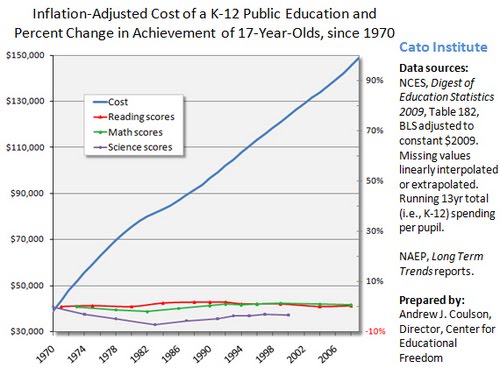
Research confirms that increased emphasis and spending on standardized testing does not produce measurable increases in student performance. As evidenced in the graph below, increased emphasis on standardized testing through the costly implementation of broad national education policies such as the No Child Left Behind Act (NCLB) produce virtually no performance increases in the presumed indicators of achievement. Despite exponential spending on such policies that promote more required standardized testing, there is no indication that these policies effectively increase student performance.

Instead, research has shown that standardized tests work to the detriment of student learning as teachers are incentivize to focus on test preparation. Rather than encouraging conceptual comprehension of the material, students are instead forced to memorize irrelevant facts and improve test taking efficiency. Furthermore, this reorientation of focus shifts classroom goals that cater to improving average scores which increases teacher attention on the average students and leaves struggling and gifted students at the far ends of the spectrum without adequate attention or support. In addition, test scores have direct repercussions on a students future, faculty tenure, and school federal grant money. The consequences of such a premium on high test scores increase the likelihood of competitive behavior between students. This detracts from the overall quality of their education and encourages unethical behaviors from students and teacher and administration. In recent decades there has been a growing problem with the proliferation of student cheating and news of countless scandals involving teachers and schools manipulating test scores for personal gain.

Recalling that standardized testing is an ordinal measurement, there is only so much value that can be derived from the interpretation of aggregate scores as an interpretation of knowledge proficiency. The varying content and difficult of any given test can only provide a crude indicator of performance that is relative to other test takers and dependent on innumerable variables which cannot be captured in a single test.

In light of this evidence there is good reason to initiate a shift away from standardized testing towards better indicators of student achievement. Research indicates that societal factors, emotional factors, the learning environment, and methods of teaching are better predictors of educational success. Additionally, there is strong evidence suggesting that high quality schools are represented by high quality faculty and administration.

The various stakeholders within education reflects the complexity of the issue. Standardized testing reinforces extrinsic motivations within society that diminish self-efficacy and reinforce values that emphasize instant gratification without long term investment. The consequences of this testing reverberate through the students and extend throughout society, affecting every facet of our culture. Solving the issue will require addressing factors relating to the classroom environment by supplying highly qualified and incentivized teachers who engage in meaningful relationships with their students, praise individual experience and inquiry over abstracted ideals, and encourage work ethic over results.


References
Citizens League. (2008, June 11). How does standardized testing impact students’ motivation to learn? . Retrieved from http://www.citizing.org/data/pdfs/sso/SSOIssueBrief_StandardizedTests.pdf
“Inflation-Adjusted Cost of a K-12 Public Education and Percent Change in Achievement of 17-Year-Olds, since 1970 | Intellectual Takeout (ITO).” Intellectual Takeout (ITO) | National Debt, Education, History, Economics, Great Depression, 5th, 4th Amendment, Patriot Act, Energy, & Human Nature Info. Web. 07 Dec. 2011. <http://www.intellectualtakeout.org/library/chart-graph/inflation-adjusted-cost-k-12-public-education-and-percent-change-achievement-17-year-olds-1970&gt;.
Popham , J. W. (2009). Why standardized tests don’t measure educational quality. Using Standards and Assessments , 56(6), 8-15. Retrieved from http://www.ascd.org/publications/educational-leadership/mar99/vol56/num06/Why-Standardized-Tests-Don’t-Measure-Educational-Quality.aspx
What’s so bad about standardized testing? (n.d.). Retrieved from https://www.msu.edu/~youngka7/cons.html
Winerip, Michael. Standardized Tests Face a Crisis Over Standards. 22 March 2006. 19 April 2009 <http://www.nytimes.com/2006/03/22/education/22education.html?scp=4&sq=standardized%20test&st=cse&gt;.

Democracy and Wealth: Athenian America

The Athenian democracy operated politically and economically as an aristocratic slave owning society. In order to be a citizen you must be male and of Athenian descent, but more importantly, you must possess capital, or tangible assets, usually land, but other times a horse was a sufficient indicator. Business and economy functioned among households, where each home was a corporation with women providing children for labor, but more importantly to inherit the capital assets and business. Slaves and the very poor non-Athenians were the laborers and looked at as nothing more than expensive tools, much like a plow or hammer or, for a more contemporary example, a car, which can serve various functions maintaining the business and household. Most interesting is that Athenian citizens universally considered wage labor to be the most debasing form of work, primarily because of its repetitive mechanical nature which requires no thought. In Ancient Greece it was unthinkable for any self-respecting citizen to ever work for an hourly wage. That was reserved exclusively for the slaves and xenos. Honorable means of income included rent, investment activities, and growing the business, whether it was in manufacturing or mining or crafts.

Some thousand years later John Locke purposed a treatise on government and politics with the sole aim of facilitating human self-preservation. For Locke, the most important and only worthwhile goal of the government was to ensure that property was parceled out and protected fairly among citizens. Locke believed that man’s naturally ordained rights were a healthy life, liberty, and property, all of which were essential for the pursuit of self-preservation. The right to property was a significant aspect to securing the other provisions that aided in self-preservation. Property, or more specifically capital assets, allowed man to retain value and worth, provided him a means of subsistence, and a means of attaining happiness by laboring his land in order to increase his value.

Capital assets, such as land or other hard assets of value, were a fundamental role to being an autonomous, equal, and free member of society throughout history. I ask myself,  what is the current state of the US economy and society, and how do we compare and stand up with the values and realizations that past thinkers and societies valued as paramount to liberalism, that of liberty, autonomy, and equality, that facilitate and ensure self-preservation?

I look around at society and I see many problems: inequality, concentration and centralization of wealth, wild financial speculation or “irrational exubrence” in investment markets, debt and credit, poverty, stagflation, corruption among politicians working for corporations and financial institutions, corporate person-hood that robs individuals of representational power and dignity, and many more. What is the cause of these problems? While I believe the questions and their inquiry are philosophical, the explanation, in my mind, is purely economical, or exists within the realm of political economy.  After all, economics is the study of human interactions within the various ecologies that sustain them. This includes every facet of the human condition, as well as environmental and sociological externalities and considerations.

Unlike many economists, my premises are philosophical and existentially rooted in a singular force that guides and shapes all decisions. This force is the will-to-power. I’ll elaborate more on the nature of this often wildly misunderstood concept at a later time.  But first it’s important to explore some assumptions contained in the prevailing macroeconomic theories, specifically the mainstream economics of Keynes, Friedman, and other monetarists.

I’ll need to explore their basic assumptions in value-theory, decision making and preference theory and their relation to various consumption theories (such as conspicuous, necessary, etc), money, supply and demand, labor markets and employment, wages rates, prices, institutions, investment and saving, economic development and growth, business cycles, the nature of competition and competitive markets, capital accumulation and its role in capital concentration and centralization towards inequality formation, entrepreneurism and technological innovation, government fiscal policies and taxation structures, monetary policies and inflation, banks and financial intermediaries, the wealthy and more. I will also explore assumptions contained within neo-classical and contemporary theories such as ceteris paribus (as well as the associated equilibrium states, atomistic and neo-platonistic conjectures and their ideal, representative variables), real balances and the Real-balance effect, the purchasing power of money, Say’s law, the Fisher effect, the nature of inflation, the liquidity-preference theory and liquidity trap, and the nature of aggregate supply and aggregate demand.

I also want to explore the how we conceive and view the role of various entities and nature of contexts, such as imperfect competitive markets (such as monopolies, duopolies, oligarchies and the like), short-run and long-run outcomes, propaganda and advertising, product differentiation, the affluent society, institutional powers and their countervailing powers, and others.

Lastly, I will examine the methodology for justifying and legitimizing these various claims by looking at various paradigms or frameworks such as those characteristic of empiricism and analyticism, and how they factor into an array scientific and non-scientific traditions like those of historicism, psychology, sociology, biological evolution, and even physics and the metaphysical reflections of phenomenology and its dialectical method.

In sum, I would like to combine understanding from all these aspects to produce a sound, organically rooted, evolutionary paradigm for political economy existing, if at all possible, under the pretext of political philosophy’s liberalism, like that found in the US constitution.

I’m so excited I’m trembling. My mind is brewing with enthusiasm. I feel like I can see through the noise, the static, perfect problems. I don’t know what the solution is, but I need to articulate the fundamental problems first. My next post will elaborate on the current issues and problems I observe within our country and explain why they exist. Specifically, I will expound on why our fatally flawed economic paradigms are only contributing to these problems.


honestus

Apparently honesty doesn’t count for anything these days. I’ve been too fucking preoccupied with god knows what to say what needs to be said, to feel what needs to be felt. I don’t need to get redundant about shit, don’t need to go off on these accusatory diatribes about who the hell gives a damn. I just need to open my little eye balls up and begin observing again, all over again, and scribble it back out like I did when I first learned how to operate a pen and paper.

Yea. I need to be realer. Is that even a word? I need to be more… I hate cliches. More ‘transparent’ with myself. Damnit. Even the sound of that makes me feel like a sap. What I mean is that there’s too much bullshit spinning around inside this head of mine, too much of a delay in what I’m thinking and what ends up coming out. I need to bypass my bullshit mixer and just get out what needs to get out. I’m talking about sensations. Not the passive aggressive regurgitation. Just plain old descriptive verbage, raw and uncensored. I need it to scathe my eyes when I read it, make me cringe and ask myself why the hell I would have ever thought that, or bothered to write that down.

You wouldn’t believe it. It’s 12:10am in the morning and the fire alarm went off. The god damn fire alarm. My ears are bleeding. The pulsating shriek makes my head feel like its inflating with every pulse. It’s gonna pop. The roommates are up, being all inquisitive. I hope they do something about it cause I’m about it rip it off the wall. I hear them mumbling, rearranging furniture, figuring out how they plan on putting an end to the chaos.

There’s nothing refined about myself. Nothing refined about people in general really. It’s just shrouded in layers of bullshit. Years and years of bullshit just wrapped around the person until they’re all blue and bloated. I can’t stand it. We always gotta censor. We’re so censored we don’t even know it. We always talk about how free speech works, how we’re all free to express whatever we want. I call bullshit. I say that we don’t even know how to talk anymore. There are repercussions when you speak your mind, when you really say it how it is. People are so god damn sensitive, so uptight, so anal about self-respect  that they become paralyzed and stiff. I just want to get angry, get emotional every once in a while. Really just yell and rant and really challenge what they believe, what they say, but with emotion. Just for once damnit. But I couldn’t do that. It would have severe repercussions. Holy shit it would be severe. I would probably fail the class– on grounds of disruption and disrespecting the professor no doubt. I may even go to jail, or be evaluated by a shrink.

Self-expression? Really? Where the hell can you express yourself in a social situation where it actually matters? Behind what doors does this work? In front of what audience? Cause where I’m from, we just conform to social expectations. We google our opinions. For how to act. What to think. There’s an unspoken code that everyone appeals to for authority, and its terrible and oppressive. It feels like its backed with power but I don’t know. We’ve obeyed it since we were forced to sit in equilateral lines in fixated seats with a single perspective and if you misbehaved, talked out of line, out loud or to others in any learning situation, you were punished. Its a code that we believe in and give it power. Its apart of our neat, tidy little world where everything has a place, where right and wrong seem so obvious. And we care so much, are so off-put when someone disrupts our expectations of things. God forbid. God forbid we just decided to figure them out. Maybe even reciprocated a little disruption back.

Ugh. That’s how I feel. That’s how I feel now, and that’s how I feel when I sit in class, or I’m at work, or dealing with anyone person that I depend on for anything substantial. Wrap that smile on, conduct yourself in a self-controlled, restrained manner, and say what they want to hear. With words. With silly stupid words that are powerless. That have become powerless. Because there is no voice. No fucking voice. No person behind them with any balls, with any heart to just call bullshit on the whole charade. The totally empty words, the totally empty life, the empty politics. And actually say what they fucking mean. What they really feel, what they really think about any shit that actually matters in their life, and just stop the role playing. All at once. Cause I don’t think anyone is going to be able to understand how and why they decided to stop until everyone just stops. Then they’ll see how this giant production is just a bunch of made up shit that nobody really believes in, but does anyway just to follow along. And that all these sick people with sick minds and sick hearts and sick bodies are really just suffocating cause they don’t fucking breath. They don’t speak. They don’t learn. So they begin withering inside, imploding or exploding like the collapse of a star or spewing supernova. They douse in alcohol and self pity, or maybe those prescription drugs their doctor dopes them with, maybe some of that black market marijuana or coke shit, and their lives fall apart. Or they just suffer quietly their whole life. Eating. Or not. Or working out with all your official Crossfit or Gold’s gym posse. A big loser. A big copy. Never really feeling anything life changing. But they sure can act the part and appear alive.

The god. The war. The drugs. The money. The school. The job. The career. The plants and animals and sky and space. All these things. The crises. The politics. All bullshit.

No one is angry. No one feels. We don’t even live inside ourselves. We just persist, waiting for new signals to program us to give a shit about more shit we shouldn’t give a shit about. The shitty new music. The new gadget. The new scandal. The failed two point conversion in last nights game. The inside gossip on who. The new style. The new news. All shit that is totally irrelevant bullshit that has no impact on our lives whatsoever. We don’t need any of that shit. We don’t need to know any of this shit. Why do we act like we do? Why? It’s fucking insane. It’s just noise. Just little blips of social DNA that tell you to shut up. That its under control because we can write out in these little digital letters and ink texts. That you don’t need to actually do or be anything. Just absorb second hand information. Suck up the viral messages. Nod your head.

I’m tired. I’m gonna read a bit and pass out. I guess what I’m saying, and I’m not even sure if I even communicated it, is that people need to speak up and give a shit about things. Period. And that when someone speaks up to you, you don’t get quiet, you get equally vocal and emotional. Accept that these matches take time and resolution. Continue talking until you are utterly exhausted, but do it with your breath and body. Tell your roommates whats on your mind, whats really on your mind, no matter how inappropriate. Tell your parents. Your teachers. Your boss. Even the police. Tell the judge. Tell them what’s on your mind. Articulate the hell out of it, like you mean it, like you have a stake in something in your life that actually matters, just for once.  And not worry about time. About formality. Just communicate.

AND I DON’T MEAN VIA CONVENTION. Don’t worry about the grammar or syntax or style. Not even the content. Just the process. Let it fly out. Don’t worry about a good thesis, an appropriate topic, or sounding like you have any fucking idea what you’re talking about, because if you actually gave a shit, you wouldn’t worry about how to not say how much you give a shit. We don’t have to recycle words. Stories. Myths. Images. Brands. Labels.

I’m ridiculously tired. I have class early tomorrow. I’m going to become more proactive observing my life for how it is, and saying it how it is instead of hiding it under formality and fear.


movere

What motivates people? A common reply may include purpose, or autonomy or self-mastery. Or maybe status, prestige, money and other tangibles. As far as what motivates me, the first idea that comes to mind is self-discovery.  But I have to ask myself, what does that mean? what does that entail? and how does that motivate me?

Motivation originates either intrinsically or extrinsically, from inside or outside. Intrinsic motivation is internally generated, emanating from within the individual, where the amorphous material of mind combine pathos and logos to meld imagination and assert new worlds. This motivation is proactive, self-sustaining and independent, it actively creates something from what is otherwise nothing, just the ephemeral fabric of mind. It requires inhabiting and overcoming the self.

Extrinsic motivation is externally imposed from sources represented outside the individual, often appearing as objective value. This form of motivation appeals to values collectively decided and mutually agreed upon by others, by society and culture, giving them a universal and absolute appearance, almost a typological and quantifiable value (think materialism or monetism ). This type of motivation is reactive, accepting the values presented at face value, prima facie, without thought of any greater personal relevance or meaning. It requires inhabiting and competing with the “herd”.

The problem I observe with extrinsically rooted motivation involves its function to divert the gazing consciousness away from itself. This diminishes our ability to assert an internal world, depleting our reflective consciousness the capacity to imagine ourselves for ourselves, and effectively starving the self of attention. Most characteristically, extrinsic motivation fosters the development of an ego which is over inflated with external valuations. This ego stands in constant relation to others as a shallow, inauthentic reflection, a massive mirror serving no subjective relevance, requiring of itself no more than a mechanical reaction to the presence of objective externalities. This type of motivation is unsustainable when there is no other, when there is no more competition with which to compare and contrast, to evaluate self-worth. This extrinsic motivation possesses strength in its ability to measure up with others in competitive judgement and valuation. Its weakness consequently lies in its neglect to measure up and overcome the one competitor of any value, the self.

Why is self-discovery motivational? Like curiosity, discovery is not concerned with pleasure or pain, riches or ruin. It embodies a naivety of knowledge that drives it toward the unknown in hopes of accumulating insight, specifically illuminating and expanding the former limits of human understanding, of possibility and potential for thought or feeling. In this way self-discovery explores and collects novel experience for the sake of feeling, for the sake of stretching prior, yawning conceptions of the human condition to surpass what was previously thought, beyond what was ever dreamed. I like to think that self-discovery, revelation of mind, of mousa, requires being maniacally mad, insanely crazed, totally possessed by imagination, by the divine powers of mind, kissed by the daimons of antiquity who breathe life into dreams.

I find myself averse to people who consistently seek happiness, contentment, enjoyment, comfort, compromise, and the like. These people are asking for enslavement, asking to be doped up with delusion. They see humanity from such a narrow view, such a myopic perspective, on such a slim spectrum, with such finite feeling. Man is not all pleasure.  Man is not all pain. There is a spectrum to be experienced. We must embrace suffering, embrace pain, embrace the dark unknown recesses and uncharted waters and new territories.  The human condition is vast and infinite, with innumerable thoughts and endless prismatic feeling.

But why on earth would we knowingly venture towards pain and suffering? Why would you actively want to hurt? Or desire to encounter a situation that you know nothing about, that leaves you totally unprepared?

In reply, I would ask why someone would sail the uncharted seas, dive to unexplored depths, or blaze unmapped territories? Why does anyone venture into the dark, into the unknown? To know! To discover! In order to render the unfamiliar familiar; so that once blind, now we see.

Is this motivated by sheer curiosity? Isn’t there something at the bottom of it all that moves us because of pleasure, because it is gratifying and enjoyable? Doesn’t this ruin my argument? I would say, not at all. Then what drives someone toward risk, to take such leaps of faith in themselves into the unknown? I believe it is not a specific drive toward or away anything good or bad. I believe it is a power, a dynamo that needs to consume, be it the experience of new feeling or novel thought.

These people, these explorers and adventurers, they are the mad ones, the geniuses, possessed by daimon, inspired by muse, who exist as an empty shell, a hallow machine, in the absence of novelty, the fuel of revelation. They are numb, incapable of feeling otherwise. What drives them toward such torment isn’t the sadist tendency towards pain, but the sovereign salvation of feeling, any feeling, be it suffering or pleasure. To feel something is better than to feel nothing. That is the only way you know you are truly alive, to feel alive.

There is no artificial progression– all is the natural corollary of what nature intended it to be! Are we not natural?

To follow your heart is such an over-used cliche. But I suppose I’m not sure what substitute would be preferable. Your mind? What say we yield to the call of our ancient Manichean brethren and  accept the duality of our condition. We exist as dichotomies, in time and space, present in innumerable moments. Are we not paradoxical? Mind and matter?

I am full of polarities, complexities, multitudes of people, no one in me, but me in all. I believe in the static and fluid, the traditional and revolutionary, the intelligent and naive, the real and imaginative, the masculine and feminine, the playful and disciplined, inside and outside, with humility and pride, with enjoyment and suffering, openness and sensitivity, with passion and objection.

This is what distinguishes greatness and meanness: to exist in paradox, to live for the sake of life, fearless of pain, of death.

*

People always want to glorify their pain, their ability to suffer, to endure, like this is admirable. Anyone can suffer. Anyone can be unfortunate. The great people are those that, in the midst of their suffering, have the courage to create themselves anew, adopt new eyes, a new attitude, and adapt their mind, their ability to overcome, and evolve as something greater, something stronger.

Most would unanimously agree that without challenge there is no opportunity for growth; or as they say, no pain, no gain. But people don’t take the time to fully appreciate what this entails, what this asks of them. It is not simply the act of challenging yourself, singly or many times. It is the act of adapting– evolving– a perspective that transforms an initially unfavorable situation and circumstance into a favorable one, an imperfect perception into a perfect one. That is the key. That is the wisdom. I like to think that this works both ways, that a genius can take a good thing and make it bad just as easily as taking a bad thing and making it good. It’s the ability to decipher the pieces and internal relationships of an object or society, pull them apart, and reassemble them to suit your ends, your perspective.

Nothing gets easier in life; you only get better. Nothing changes until you change. Our perspective, our mind and heart, these pools of liquid light, need to remain fluid, need to be stirred and churned if they are to retain their maleability, their adaptability.

This is why we seek out experience for the sake of experience, understanding for its own sake, the orderly and beautiful, as well as confusion, the chaotic and appalling.

ad astra

But I am a star,
burning in a sea of space;
I have no arms,
no hands
to reach that destined place.

Gravity keeps
my spin aligned,
crushes my being
to burst forth
in shine.

There is no destination
when I revolve
around myself,
no lost and found
by which to mark
my health.

I am not a man
but a glow that beams
across the hearts
and minds,
(those heavenly oceans)
of imagining.

I am a star,
suspended
in a sea of space;
not an ideal,
a hope,
that consumes no space.

I am my own star
among the desert sky,
with my own weight
and gravity
to aid me by.

Discontents with Modern Economic Theory

I’ve rambled and wrote before on this topic, but I need to say it again: Modern economic theory is baseless bullshit.

As a philosophy major I like to pride myself on being able to look beyond the obvious, beyond what’s presented prima facie, identify shortcomings of any claims, and ask the tough, pertinent questions. That being said, I’ve spent a lot of time as an undergraduate studying economics and finance and researching  the shortcomings of the various economic assumptions built into the economic theory, their models and methods, and the policy decisions stemming from them, and I find that the vast majority of it is unfounded speculative assumptions.

Fundamentally, modern economic theory is not scientific. It is pseudoscience. While not the first person to call bullshit on the neo-classical economic theorists, Imre Lakatos did a fine job making explicit  the shortcomings of their neo-classical claims in the seventies along with his colleague Spiro Latsis in their paper Situational Determinism. This shed light on the flimsy assumptions grounding their  theories and encouraged other economists, as well as academics from other fields such as psychology, to revise many of their assumptions in favor of a more holistic, organic, and biological representation of economics, resembling a more accurate ecology of evolving human interaction. These minds produced what we now know as behavioral economics, institutional economics, environmental economics, and the most promising and nascent of all, evolutionary economics.

I’m researching a thesis topic for a macroeconomic policy seminar class so I can write a twenty-five page paper that examines and suggests macroeconomic policy. I decided that I’m going to get radical about this paper. I’m tired of holding my tongue when we sit around semicircle in class dithering on about these abstract relationships concerning abstract entities while we posit our way out of real or hypothetical economic problems with totally ad-hoc assumptions revolving around contemporary fiscal and monetary policy. It’s all bullshit.

Economists are bullshit. They are modern day bishops that instruct the quivering masses how the will of god should allot the gold reserves pinched from the pockets of these people, but in this case we have economists who, divinely ordained via their institutional accolades, instruct the blind herd according to the will of Adam Smith’s invisible hand. Which, like god, doesn’t exist.

So I’m trying to figure out a paper topic while using some tact. I’m not trying to offend and piss off my professor who, may I add, is one of the most highly respected professors at Vanderbilt, and one time economics adviser to Reagan.

So…my paper topic. There are a ton of areas I want to address. Most importantly I want to ensure that my research retains a Political liberalism framework like the one inherent to our democratic constitution. I’m not sure this is possible, however, without introducing statism. Whatever the case, I don’t think economics and political ideology can even be dealt with separately, so I’ll at least try. Some of my ideas involve discussing to formation and nature of:

  • Investment: Speculation and bubbles- Prevention policies
  • New Value-added Market Creation, Expansion, and development
  • Capital accumulation: concentration and centralization
  • Manufacturing v. Service industries as value adding enterprises
  • State Capitalism and Free Market Capitalism
  • Market Failures & Financial Regulation– Intervention Policies: Why consistently in the finance industry?
  • Credit and Debt markets: their dangers and shortcomings
  • Economics Schools and their policies: Mainstream economics v Austrian School v Modern Monetary Theorists (Neo-charlatan’s) v Market monetarists
  • Challenge the scientific validity of neoclassical economic models, methods, assumptions and their policies
  • Challenge the validity of Milton Friedman’s Economic theories, including his Free Market Hypothesis. (Also Keynes. And perhaps examine, compare, and contrast with that evil called “Marxism”)
  • Examine modern consumer theory, value theory, theory of productivity: Suggest alternative paradigms and their policies


Anyway. I have other things to do, quizzes to take, reading to finish. More thoughts later.

Problems Don’t Exist.

Passion is powerful. You can’t be all thought, all machine, calculated and cool. You need warmth, fire, some fuel to spread your light. But I despise drama. Drama is unnecessary theatrics.  It is passion with problems. Problematized passion. It takes good genuine energy and creates problems rather than solutions. People who attract drama feel insignificant without it. They lack an ability to exist in tranquility. It’s almost as if they think that drama gives their life character, somehow makes them strong or resilient for persisting through these problems, problems they create within abstract of their mind. They take a perfectly good life, and instead of applying their passion, their life force and energy to synthesizing new solutions, they problematize a good thing. Of course they talk like they don’t like the drama, like it weighs on them, like a millstone they carry with them. They are constantly talking about the day when they don’t have so many problems. They are the first ones to talk about discarding this laboring load and equally quick to point out how  badly they want to set it down and dispel the drama, but they continue talking, thinking, seething about their problems, adding potency to their diluted delusion.

Problems do not exist. There. I said it. Problems are only problems when you identify them as problems. Before they are identified, we accept circumstance and situation, absolving that that’s just the way things are, for better or worse. Perhaps it is a skill to be able to identify problems, to label things are deficient, broken, and I bet it takes a critically inquiring eye to do this. But where do you draw the line?

Problems are not problems. Drama is not drama. These are facets of life. Contrary to the clamoring chorus of capitalist commercialism, our life does not need to be problematic and dramatic to be glorious and grand. They profiteer off such knave  propensities for ease, for life without suffering. They drain you of your liquid wealth and welling life as you train to maintain and gain a greater sense of self, a sense of self complete with all the accessories they sell your squeaking soul. But your soul needs no oil. Let the soul, that broken squealing soul, scream, let it scream and burst forth in melody, let it create harmony with other squeaky souls. Do not oil. Warm yourself with its friction, these triturations of life. Soon your stridulating soul will begin to warble and transform into a beautiful hum, a harmonious vibration that echoes across cold chambers where copious copies of silent, gunky souls reside, soiled and slow from the years of feeble fabricated fixes. There is nothing wrong with your soul. You are perfect as a diamond is flawed, stronger than all the universal forces and extraterrestrial elements, pressed and latticed in structural perfectitude, lined with innumerable inclusions and trace elements that straddle its knitted bonds, strontium and nitrogen, rubidium and barium, adding to the refracting flash that douses the senses when you allow transparency and light to work their way within you and shine forth.

Problems do not exist. They are in your mind. If there were no mind to observe, no eye to see, there would be no problems to probe. Overcoming yourself is a task which has no end. The road up a mountain is the same road down it. Do not confuse your life’s task, your journey. Do not tire yourself with the trifling pursuits of climbing the insurmountable where barren cliffs and cleft rifts and ice tips are all that waits you. Go instead down the road, where momentum is your friend, and follow the valley where the streams merge with rivers and  gather into looming pools and luscious lakes and lead to opulent oceans that provide cooling relief under the dense shade of living vegetation. Go where there is life.

Problems do not exist. Life begins in consciousness. Life is not simply physical minutia, else the moons and marbling spheres and stars and solar systems be living. Life is not simply movement. It is purely imagination. No mind exists apart from the life giving force of their imagination. Our eyes cannot capture meaning. That is reserved for our minds. Do not forfeit your mind and believe your eyes. Do not let your ears consume the drunken speech of other grey minds, their crannies and crevasses all canvassed in web, caught in a tangle of dense delusion, of smog that blocks the breathing flue, changing flowing channels into choking chimneys, and strangulating the stronghold of being.

Problems do not exist. They are created, by us, to achieve ends, fabricated ends, short sighted ends, poor hallow ends. Until we believe that our means are greater than our ends, we will fail to dream, fail to see opportunity where there is challenge. Our lives will encapsulate a silent storm of tears, sleeting, frozen over from lack of warmth, from lack of friction with the world, lack of authentic abrasion that causes aural ambage.

Problems do not exist. People sell you problems, don’t sell yourself problems. Don’t add insult to injury and do the job that capitalism, commercial advertising, has perfected. Problems. Everyone wants you to believe that there is a problem free life– that can be achieved by means they can provide if you forfeit a small payment in price, a small piece of your time, a fraction of your wage. We will provide you the happiness, the comfort, the pleasure, the distress-free existence if you pay for it. But this is a lie. There are no problems. And the people who buy into the problems die poor, poor in pocket and poor in spirit. They failed to save, failed to build, collect and create. They diluted themselves with the quick fixes, the shabby solutions that clutter their consciousness, until they are wrapped in flax linnens and preserved in a perfect state of lifelessness.

Problems do not exist. What exists is desire for power, power over circumstance, power over passion, power over thoughts. These people die a slave. They never learned to revolt, never embraced the chaos, the flowing flux that embodies a living life, and rebel as a self-sustaining individual, perfectly punctual in the moment. Defining and confining, constraining and restraining.

Problems do not exist. Mind exists. When our mind identifies a problem with some thing, it is not the thing that changes, but our mind, our relation to that thing. Our mind is eternal, but our attention is finite. We cannot allow ourselves to be preoccupied with any thought or feeling that does not deliver grandeur to house of being, or fails to cleanse our doors of perception. We have one life, one spectacle, a single show, a solemn act to perform. We must choose the words that echo into the ears of eternity with heart, with care. We cannot think our way out of a state of being, a dramatic scene of tragedy, we can act our way out, only feel ourselves into another line, continue playing a developing role to an ambivalent audience.

There are no problems. There is fate. There are ends. There are expectations: faulty suspensions, wry calculations, aslant anticipations. Properly viewed, problems are merely  stepping stones that carry you through life.


Anyway.

I believe that love for a subject, passionate unrequited love, is the only way to let yourself gain any appreciable acquaintance, since love is selfless devotion. But I’m not sure we can love people before we love ourselves. We love the me we see in thee.


Tsap

Many people like to look at the timely world in a forward fashion, with their gaze pressed upon the horizon of new experience, their eyes unfolding new sensation, enveloping new consciousness, and they watch it bloom and expand into carpets of rolling memory. But I’m not sure how much I like this configuration of time and our relation to it.

I like to think that, rather than looking forward into the unknown with the past floating in a dry haze behind us, we are actually facing the past, with our back pressed against a dimly lit future.

I like to think that we walk backwards through life, and this is a more accurate way of representing it, is it not? We cannot see what lies before us until it is already there, under our feet. Our gaze extends, not towards the future, but forever into the past. That is where eternity lies, after all, in our minds, the historical annals of our sensual experience, the tombs of fabricated memory, of associated feeling and dissociated thought. We take steps, feeble, trembling steps, into the unknown, feeling precariously, toeing every pebble and crevasse underfoot, bumping along here and there into the unfamiliar. Every parchment of new sensation is written over top great works in progress. We become contradicting stories, never ending narratives.

Our past is our best indication of the future. If we took no time exploring our past we’d be ill equipped to face the future. You just can’t run into darkness with aimless abandon without fail. You need to keep your sight on the light so you don’t lose yourself. The past is the only reservoir of light that can be of any aid, the lighthouse of life. But we often forget that. We often believe we’re on a new frontier, that our technology has somehow allowed us to transcend our basic impulses, our primal urges, our barbaric desires, our calamitous caprice, our vague vagaries, our sybaritic sensations that wind through our bodies and seep through our pores, into our gestures, and electrify the swinging swoon of destructive fiery passion, and pour through our mouth and into the ears of each successive embryonic mind.

Seething and breathing

Chomping and stomping

Crematorium and sanatorium

Places for the faces

Dread for the dead

Lovely lilacs

We live in the past. We must learn to recreate the past, to fashion it according to our imagination. Use the past as fodder for thought. The fantastical lives with the past, not in the future.

Fid

Words are like capsules of feeling. When properly strung together they become pearls that you wear in your mind so that the light of experience reflects and refracts into a brilliant rainbow of color, decorating and illuminating your inner chambers of thought.

Confidence is attractive. Why? I believe it has something to do with appearing genuine. I know that’s a load of crap, cause being confident or being genuine doesn’t guarantee one or the other, but I believe we like to think it does. When you aren’t confident, there’s uncertainty. And people become uncertain about their impression of you. People like control. They like a world and people they can count on. If you aren’t confident, you probably can’t be counted on.

I’m not saying everyone should be confident… but yea, yea I am. Fake it. I believe you should be confident about your shortcomings, about your limits, about your lack of understanding, about you strengths, and so on and so forth. Be confident where you stand. Be confident that you may be wrong. Confidence manifests as assertion, as declaration. It’s important to project yourself onto the world, every facet and flaw and gem of glory you possess. That’s the only way to truly know yourself. That’s the only way to truly be yourself. And as you gain confidence, you gain a greater sense of being. And you begin to incarnate an ever evolving life that effloresces in time.

*

Moments and modes. My roommates use these words to describe what appears to be my various desultory states of being. I change modes, overturn ethics and morals, undermine and contradict myself. For the moral man, this behavior appears inconsistent, untrustworthy. But I don’t think I could ever trust myself, my thoughts and conclusions, if it were any other way. I like to think that adopting different modes allows for the advent of new perspective. The only way you gain perspective, I believe, is if you change some variables, like values or the weight or significance you give to certain entities and activities and events in your experience.

Some of my modes include prioritizing writing, introversion, reading, an antipathy for socializing and culture. Others include the opposite, where action without much forethought is prized, where people and relationships are put on a pedestal. And still other modes include a mentality of pure success and domination, a lack of empathy and care for others that fail to aid my journey of achivement. But there is a spectrum.

People can be bland. (I can be bland, that’s why I feel like I can make that statement) Maybe adopting these modes all the time makes for unpredictability, but isn’t that life? We try to control, control, control. Which is nice in some modes. But you really can’t embrace the idiosyncratic fluctuations of colorful experience when you’re in complete control. Your control, the premise for your control, is that the future will be like the past. But that certainly isn’t the case. And additionally, that mentality doesn’t allow for the variegation of change to work its way into your life so that growth can take place.

I was going to say more, but whatever I was thinking escaped me.

So this semester I’ve been on the domination streak. Not much thinking, and it’s been feeling great. Lifting six days a week. I weigh 195lbs now at roughly 15% bodyfat. Not shabby. Feeling all nordic and vikingish. Getting strong. Doing my work. Taking 18 hours. Working 15 hours (or struggling to work 15 hours). I’ve been allotting time for socializing and pleasure. I’ve been practicing my guitar quite a bit, and even formed a little jam band with my roommates. We have a drum set in our dining room now. It provides a nice, Nashvillian decorative touch.

I actually have a lot that I could write about. It doesn’t ever occur to me until I begin writing, then it just starts pouring out. I have class. Write more at a future date.

Insecurity

The less confident you are, the more serious you have to act.
-T. Ploughman

Why are people insecure? How can you spot insecurity? Insecurities are funny. On first thought, when I think of someone who is insecure my mind immediately imagines a meek, timid, closed off person who visibly suffers from low self-esteem. On second thought, my mind thinks about those people who always tout their abilities and accomplishments, like they are seeking validation from other people.

It’s the second type of person that is most intriguing. Many times they display a show of self-confidence. They may even be very adept at a great many things, but they seem to consistently feel the need to remind everyone how great they are. These people often fly under the radar when we think about people who are insecure. Or maybe not. But they are everywhere. It seems we have a society full of insecure people.