Transcend

The biggest lessons I always get (or at least am reminded of again and again) out of negative episodes, is that the more I fixate on the problem, the more I prolong it.

It’s becomes a negative feedback loop, that eventually spirals out of control.

I can obsess about thinking myself out of the problem. But it just exaggerates it.

Accepting the problem, and embracing the negative episodes, is quite literally a skill.

The ability to transcend the discomfort or pain.

It’s essential for achieving anything.

Life is suffering. That’s the Buddha’s first noble truth.

Learning to transcend and operate from a place beyond it allows us the capacity to overcome it, and find some joy or peace.

It’s like the only way to avoid suffering is… do nothing. Say nothing. Be nothing.

But I feel like you still end up suffering.

Every choice has a risk. Even no choice.

Also, there are those (myself included) who attempt to eliminate suffering by control.

This can lead to neurosis. You can’t control everything, and you can’t control people. No matter how sophisticated your plan. Life is unpredictable.

And there are those who try to eliminate suffering by surrendering control. They avoid conflict. They retreat into a comforting place, away from the chaos, where they find equilibrium.

I do think that having the courage to confront conflict head on, and engage with problems and the world, is where personal growth and the source of strength is cultivated.

I think those situations teach you wisdom about what you can control and what you can’t, and how to optimize your attitude and approach for each.

I think gaining distance from thoughts, feelings, and states of being are crucial for any intelligent change.

Meditation. Personal reflection. Journaling. Objectively discussing these situations, with trusted confidants, or in therapy.

They instigate self awareness.

If you aren’t self aware, you’re a hostage to these unconscious habits and drives and primal reactions.

Stepping back. Gaining perspective. Seeing your “self”.

Quieting the conscious “noise”. The mess of feelings and reactionary thoughts and tangled attention.

Allowing the unconscious to achieve space to reveal itself.

What’s really going on here? Who is that? Why is that?

Then you can change behaviors, thoughts and feelings about things, which allow you to escape from the habituated patterns of mind that thrust you into the same dilemmas time and time again, and set in motion a new chain of events that produce a different set of outcomes.

Which you likewise must inevitably wrestle with.

The process of self development. Self mastery. Purification.

Obsession

The more obsessed you are to a cause or vision or goal, the more dedicated, absorbed, and focused, the more dominated and possessed by the compulsion to analyze and act and repeat with persistence, like an addiction, like a hunger, like your life depends on it, no matter the struggle or set back or stagnation… the more successful you’ll be.

Some people balance this better than others.

Some are more neurotic. Some are more composed.

But in the end, your level of consuming obsession dictates your ability and speed of accomplishment.

Cliche Self-care

Sometimes I want to stop this “self improvement” philosophy bullshit, and stop all personal development, just out of spite. Like, stop all these attempts to purify character and attain virtue and cultivate principles.

Does anyone feel like it’s cliche at this point?

What does it all mean?

Everyone seems like that’s what they do. Or post about. Or read. Pictures of their self help books. Their feel good quotes. Success thus and achievement that. Peace and love and yoga for enlightenment and meditation yay.

Living? Learning from experiences? Isn’t this what happens by default, from living?

Must we (I, or millennials) be so obsessed with cultivating skills and improvements and success? (I often feel it’s an illusion, to comfort ourself from the bane reality that existence is mostly trivial chance. The illusion of control, the illusion that we can “fix” ourselves, like we know what that even means, like we know what a healthy or happy self even looks like).

Sometimes i just want to fail. And like. Live with that failure forever. Never fix it. Just be a piece of shit. But. Still live, and thus, still get things done. Cause survival. And the necessity of survival.

And by being a piece of shit, I don’t mean being a malevolent malicious asshole.

I just mean, stop caring about anything that doesn’t directly effect me in the hear and now. No planning. No dreaming. Just be. Maybe fuck and drink while I’m not eating or working.

Blockchain Is Engrams

Blockchain: truncated or hashed blocks of data linked together with time stamps and addresses that point to other blocks in a sequence.

It’s all encrypted, so your key is what gives you access to that block chain: the key is what gives you access to that data, that string of blocks, which is denoted as a token.

Do neural networks work in this fashion??
Memory retrieval?
https://en.wikipedia.org/wiki/Engram_(neuropsychology)
https://www.scientificamerican.com/article/how-the-brain-builds-memory-chains/

I think that our minds and mental byproducts like ideas and concepts and processes, are just another expression of underlying forces governed by physics, just like biological evolution.

Blockchain = engrams
Key = event/stimulation
Engrams are fuckin fascinating
Nodes= neurons
Brain = network

I think learning as a process of refining inputs to achieve optimal outputs is different than memory formation in this regard.

Imagine combining the two

Imagine, storing data on the network, in block chains, utilizing keys to gain access to specific data sets, and applying neural net learning with keys, where keys are encoded Blockchain data.

Does that make sense?
So there’s the learning process, then there’s the encoding process of what we learned, ie knowledge

Imagine an AI that utilized the web this way
Stored it’s knowledge in blockchains, across the network.

Where is a memory in our brain?

It’s not in one location.

It’s stored across the network, as a pattern= engrams

Engrams= blockchains.

Adult ADHD

I was diagnosed with ADHD when I was young, in first grade, and it mostly manifested as distractibility and boredom. It didn’t affect me academically until studies grew more demanding, such as late middle school and high school.

It was something that really affected me, really frustrated me, and affected my self esteem.

I hated the label, and I hated being treated differently, so I denied it. But it didn’t help anything.

You grow up feeling different, and isolated, like there’s something wrong with you. The easiest tasks for others, seemed monumental for me, and impossible.

Usually there were large discrepancies in my grades. Didn’t matter the subject or the difficulty. It all revolved around my ability to become engaged with the subject. Even if it were easy, if it wasn’t stimulating or challenging, because of the material or the teacher, earning easy grades wasn’t so easy.

It wasn’t until I began college did I learn about coping strategies and study habits that were absolutely necessary to overcome it.

The other thing is that, when you have it, you’re totally unaware of how and when it manifests until someone points it out. Or until life abruptly reminds you that you aren’t doin it right.

The inability to focus and become highjacked with random, lateral thoughts is something that’s normal, for ADHD. It’s the operating process that’s governs every moment of your life. So there’s no alarm or indication something is wrong until you’re reprimanded or criticized by others. This is the part that slowly begins to wear on your self esteem.

I found that once I understood the way my mind/ attention worked, I could implement these strategies toward any undertaking and domain and succeed.

There are still some domains where I know I’m not suited, such as repetitive, detail oriented task work, clocking in at a 9-5 and sitting still all day. I become depressed and under-stimulated and work becomes hell on earth as I’m left to cope in a figurative straight jacket.

Jobs such as sales, management, entrepreneurship, project management, etc require more multitasking and are more stimulating in general.

The other area it manifests is relationships. The inability to provide sustained, reliable attention to a person can be frustrating and confusing. It’s something that’s maddeningly difficult to be aware of when it’s happening, and control, and requires immense energy to manage, which becomes exhausting. The other partner often feels uncared for, not listened to, and often unloved by the inconsistent attention and feedback.

For all its downsides, the upside is an uncanny ability to hyper-focus on specific tasks or subjects, which allows for incredible absorption of information, at the expense of everything else going on around you. Absorbing information and learning in this state is almost effortless, as you become entranced into a deep meditative state of engagement.

Coping strategies help facilitate this hyper focus, but they can’t guarantee it on call, or necessarily at will. Which is why deadlines can be troublesome, if the strategies are not practiced and implemented daily.

The other benefit is lateral thinking. Because the ADHD baseline lacks a basic stimulus filter, which most people use to easily ignore mundane or seemingly irrelevant information to the task at hand, it can be immensely helpful when problem solving. The ability to capture or register excess information leads to out of the box or lateral thinking that can be leveraged for problem solving or creativity.

I believe ADHD is vastly over diagnosed, but there is scientific consensus that there are neurological differences in these brains, which brain scans reveal.

I think that our current education systems caters to a very specific type of learning, which is very formalized, passive, and emphasizes rote memorization, and lack of any meaningful engagement. There are teachers who are amazing, and buck this trend, and for those I am forever thankful. They reminded me that I’m capable of learning and excelling, despite past experiences.

Whenever I listen to anyone saying anything interesting or stimulating, my brain just starts convulsing with ideas and tangents and thoughts, which is overwhelming when you have to focus and listen and reflect at the same time.

I think meditation is crucial, and I also think exercise has a lot of parallels, and provides the same or similar benefits.

I think “will power” or “self control” plays a role in both, even though there’s a ironicism to that, when speaking of meditation, which appeals to “losing the self”. But I think someone that can do that has the most self control of all, which is what I’m pointing to.

I would like to explore mindful meditation as much as I’ve explored the role of focusing and using will power to exercise intensely.

I imagine any serious athlete can relate to the meditative mental state that is achieved when exercising. It’s something that you must practice. It’s not just going through the motions in the gym, or running, just like it’s not going through the motions and sitting still with your eyes closed for 30 minutes a day.

To become great, you must learn how to control the mind, control the attention, choose your thoughts, narrow your focus, and let all distractions pass through you.

Pain, distractions, stress—- they are all irrelevant states of being that hinder self actualization. Unless you can actively bypass the impulse to yield to them, that hijack your state of being, you will not achieve your desired state of being—- or goal or feeling or whatever.

I do think there are parallels.

The mind is a muscle, I believe. The same principles apply to training both for maximization.

Ironically, I feel that the people who have the most self control, are best at giving up all control. They don’t try to control. They simply manifest intentions, which seems like a higher level “drive”, which produces less “resistance”, in the form of emotional stress or mental anxiety.

Intention is almost passive, like the unconscious mind takes the wheel, and just manifests the desired “state of being”
Exercise and diet has been the best mood and mental stabilizer.

Intense exercise that challenges the limits of the body, and a high protein, high veggie diet with carbs when needed had historically manifested my best self, my most stable self, whatever the hell that means.

Personal Investments 

So, years ago this is what I began realizing, and rationalizing.

I began to take stock of how I spent my time on any given day, throughout my life.

There are things I spend a lot of time doing.

I consider my time valuable.

However I spend that time I consider an investment. In my life. In my quality of life. And my overall well being.

I spend a huge majority of my life doing the following:

Working
Sleeping
Eating
On my computer/ work
On my phone/ personal/ work
Working out
Listening to music
Enjoying my alone time/ reflection

I examined the factors involved with each of these, and decided that anything related to any of these activities is an important investment.

I decided to not hesitate when spending my money on these activities. And spend less on other bullshit.

As a result, I chose to invest in the following:

-Quality clothes suited for my work life
-A quality bed that improved my sleep
-Buying quality food, even if it means cooking daily
-Buying the best computer so I can do my work efficiently, without lag or malware, or other shitty bs
-Buying the best phone whenever I need it, whenever the time calls for it, since I spend probably 6 hours a day at least on my phone, texting calling emailing or surfing the web
-Buying supplements or gym gear that will help with quality exercise
-Buying a sound system that is easy to use and produces quality/ pleasing sound
-Buying a nice couch, because I spend hours a day reading and reflecting and relaxing there, and also art that inspires reflection and thought

Most people these days spend more time on your phone than any other device. It should be one of the number one investments, or purchases.

I email. Pay bills. Tracking investments. Banking. Take pictures. Videos. Do work. Message. Call. Etc etc etc.

No one should hold back on Buying a fast, functional phone, even if it means buying a new one every 1-2 years
I’ve also found that when you pay more upfront for a good phone, it’ll last longer.

The more memory and faster processor will accommodate any future upgrades than a base model, so you may end up saving in the long run by buying less frequently

What Is Life

I’m in my little room, located on the co-op property owned by Scott’s family, laying on a large gray memory foam bean bag, overflowing with this weeks clean laundry, which act as my pillow, and blankets.

The autumn air seeps into this crannied space, through the cracks and thin paned widows; its cold steely bite hangs in the air, and nips at my skin.

I breathe. And catch my breath. I listen to myself. The air feels anxious; tension constrains a steady inhale and exhale, giving rise to the slightest hesitations in my breath, that scribble the empty silence.

Planes soar overhead, cutting through the distant atmosphere, and echo through the redwoods outside this space, throughout the room.

My life. What is life?

A 31 year old man, who has come to Palo Alto, to work with his college friend on a business, a toy business. I toil day in and out, building this business, with little idea of the outcome. Only goals and visions drive me forward. Hallucinations and delusions and fantasies that I yearn to make real, for myself, for others.

I work. I eat. I sleep. I drive to the city to see my girlfriend. Hours a day. I picked up smoking cigarettes. Sometimes 5 or 6 or 7 a day. I hate it, but the fixation never left. It was only substituted by other fixations.

I am happy, no?

I feel old. Worn. Played out. I contemplate next steps, in life, in visions, in fulfillment. Balancing patience and urgency, feeling the weight of time, the rush of time, as it moves around me, through me, faster and faster. Must I move as fast? I will die soon, and this life will be a memory, a fading recall of disappointment or content, however I decide to rationalize my failures, and commensurate my attempts at living a life worthwhile.

There is life in these bones, somewhere. In this head, sometimes.

My family is far, in body and spirit.

I am alone. I was born alone and I will die alone. There is no comfort in between, knowing this is just a waking dream.

Where must I go to find solace? Where can I escape the dark shadows lurking behind every illuminating joy?

Am I the master? Where has my imagination gone? Where are the possibilities that pave my path, that forge my resolve to tread onward, through the darkness?

Cathedrals by day turn to mausoleums by night, and my liberation becomes the heavy burden which chains me to myself.

Only you have the power, my conscience whispers.

What is thy name? How can I call it forth? I need to conjure these spirits. Speak to me now.

Scaling Laws: Thermodynamics and Evolution 

This podcast (Waking Up #86 From Cells to Cities) relates to the thermodynamics of evolution, and Jeremy England’s work.

Geoffrey is discussing scaling. And how Energy consumption decreases the more complex an organism. If a cell requires x amount of energy, then a larger biological system, in proportion, requires 75% of the amount of energy to function.

This lends itself to biological systems as being efficient energy diffusers. And explains (in my mind) the driving force of evolution.

There are these power laws that occur when you scale things, like biological organisms and companies and cities. These power laws revolve around the power of 4: for every order of magnitude increase (or double in size), 3/4 or 75% of the energy is needed.

Some things are linear, like heartbeats, the length of aorta, circulatory system, etc.
Metabolism is one of these things that follows a scaling law i.e. Energy consumption.

“Network systems” is what they are referred to when applying the power laws of scaling.

Increased complexity allows for more efficient energy capture and diffusion of organisms.

Evolution is driven in this way. Biological systems evolve in ways that make them more energy efficient.

He examines not only biological systems, but all network systems, such as sociological systems like small businesses vs large corporations, etc.

These scaling laws hold true.

The larger the organism, the slower the metabolism, and the longer it will live, is one of the conclusions.

The evidence indicates that biological systems evolve to become more energy efficient and that evolution is dictated by this demand.

The organisms that don’t follow these scaling laws, for instance, when the environment becomes unstable, die out, as per natural selection. But the ones that continue surviving, and adapting and evolving, do so in a way that captures energy and diffuses it most efficiently.

Obviously when the environment changes, and energy demands shift, and adaptations can’t occur fast enough, the organism dies and the larger the organism, the less adaptable, from a genetic evolution perspective but the smaller the organism, the faster it can adapt to those changes just like small vs large organizations when market forces shift and change.

Larger organisms typically cannot evolve and adapt fast enough to keep up with changing demands, whereas smaller companies are more flexible and adaptable But, larger systems are much more efficient, when there is stability If you look at the genetic timeline, organisms always trend toward more complexity, not less Evolution tends toward more complexity.

That’s what the evidence indicates.

So there is a “driving force”, because it would be such a obvious tendency, the evidence wouldn’t be so conclusive and Geoffrey’s research looks into complexity, and what happens when things are scaled. From the physics perspective, this complexity always leads to more energy efficiency.

You can listen to the podcast and hear his discuss the research when looking at mice and elephants, or bacteria and larger organisms. And the mechanistic evolution is linear, but the metabolism is not. The larger the organism, the less energy it is needed, proportionally, to fuel it. The metabolism is slower.

This further illustrates, to me, that the driver behind all evolution is thermodynamics, i.e. energy driven.

Life is the only “material matter” than increases in complexity, rather than decreases due to entropy, over time.

How is this explained? Energy/ thermodynamics is the primary driver.

That’s the only way this phenomena makes sense. There is no obvious “cosmic” purpose. It only necessitates evolution, as a natural law.

Fractals play an important role.

Archetypes and Truth: Jordan Peterson and Sam Harris

Jordan Peterson is more an anthropologist studying the historical development of consciousness through culture, by examining stories, and the universal archetypes— themes, motifs, symbolism— found throughout.

As a professional, clinical psychologist, this is very useful, especially from a therapeutic perspective.

You cannot discount his analysis, which is hardly his own (Jung, Campbell, Nietzsche and many others laid the foundations of this study), from a scientific research perspective, because there is ample evidence supporting these conclusions.

But his conclusions lead him to believe in a moral superiority of certain belief systems, that appeal to the highest demonstration of their efficacy.

As in, the metaphysical archetypes he identifies as transcending culture, as being universal across time and space throughout the development of mankind and civilization, leads him to conclude that Christianity provides one of the most useful embodiments of these prevailing structures that allow for maximum human flourishing, as forming the basis for a stable psychological disposition which translates into functional social structures.

This poses problems in his analysis of realism, or scientific materialism, which seems to be secondary to his “psychological metaphysics”, for lack of a better word.

Which is why the whole disagreement between Peterson and Sam Harris of “What is true?” appeared to be such a clusterfuck.

The archetypes Peterson (Jung and Campbell and others) are referencing are metaphysical structures governing the collective unconscious, i.e. they structure our conscious experience in a meaningful way, that allows us to act and make sense of the world and our relation to it and other “minds”.

Because they are universal in all mankind (based on textual analysis of stories throughout history and cultures) they provide a basis of truth, in Peterson’s claim, because they operate a priori as mediating our experience with the world.

According to Peterson, if I’m not mistaken, there are systems (cultural stories and the worldview they create) that are better than others at leveraging these archetypes, which allow for better engagement with the world, leading to our self preservation as individuals and society, which refers to his “Darwinian” framework.

I really appreciate Sam Harris’s criticisms, and I think he’s right to challenge Peterson on some of these points, such as, what is grounding this analysis, which seems much like a hermeneutic exercise of interpretation, which leaves the door open to some… baseless or imaginative conclusions

I think Peterson’s appeal to archetypes “as truth” resides in the fact that these archetypes are so enduring…. they are constantly relevant, and map onto the human experience regardless of time and place. But this notion of truth has less basis in realism, which appeals to an objective reality outside ourselves, and more basis in wisdom, which appeals to the subjective reality within ourselves.

So there’s some endurance to archetypes, some persistence to these structures, that would seem to indicates their necessity as inescapable “truths” which govern man’s conscious experience— as it relates to man’s experience with himself, others, and the “world” or “chaos” outside him.

Archetypes are metaphysical because they exist a priori, as apart of our subjective consciousness which we bring to the world, but they don’t exist in the world concretely.

Archetypes are just descriptions of relationships between man, himself, others and the world. These archetypes are not paradigms; they are more fundamental.

Good and evil, order vs chaos, protagonist vs antagonist, sacrifice vs gain— I believe these are more representative of archetypes.

Archetypes are elements constituting the unconscious experience, as “primitive mental images” representing experience.

Archetypes are unconscious: they manifest themselves through our actions. They are like an imperative governing our unconscious behaviors.

Basically, across time and culture and history, man has acted… he has developed and he has explained his experience through stories…that explain and justify his life and experience. Bible. Gilgamesh. Koran. Vedas.

What emerges are themes and patterns in these stories… no one was conscious of these themes and patterns, yet they emerge throughout mankind regardless of geography and culture and time.

These are archetypes, and they are not something easily dismissed, because they appear to be so universal and enduring.

Man is mostly unconscious. We do things we are not aware of all the time: why we are attracted to certain things, why we feel certain things, etc.

These are a primitive response. Fundamental to our makeup.

Through reflection we can gain insight into our unconscious drives.

But the point is, they are fundamental to the human experience, and apart of the “collective unconscious” experience of mankind

Imagine you are studying tribes. These primitive people have stories, common narratives they retain and exchange. The content of these stories of disparate tribes in Africa and South America and Australia are all different.

But when you examine these stories, common patterns emerge, universal forms that shape these stories in a common way.

The relationships within these stories overlap.

These tribesman are totally unaware of why they have these stories. It’s simply their experience.

What Peterson and Jung and Campbell and Nietzsche (and many others etc) look at is what is significant about these enduring patterns?

These patterns are archetypes. Studying history and stories gives the researcher awareness of these archetypes, which can get extremely useful in our own life (hence the therapeutic value from a psychological perspective).

Have you ever been to psychotherapist? You tell them your life. Your tell them stories. As you objectify these life experiences, and tell your stories, you become aware of things you never considered. You realize why you have certain feelings. Trauma or pain or certain associations imprinted on the mind while you’re developing lead to unconscious behaviors that operate throughout your life, sometimes positively, sometimes negatively.

In order to gain self mastery, or self awareness, you need to make yourself aware of these unconscious behaviors.

These unconscious behaviors have universal roots in the human experience… these are archetypes. Apart of the universal human condition.

We find these relationships throughout history in every culture and all literature.

There are common patterns of engaging and reacting with the world and others and ourselves.

Peterson and others are attempting or are building a case that grounds this neuroscience. That’s their aim.

Archetypes manifest themselves, and only retroactively do we gain awareness of these patterns, mostly because we’re embedded within them.

Primitive man, the unreflective “man” is not aware. He acts out of instinct. You can observe his actions. You can examine his culture and society. And patterns emerge— Archetypes.

Whether man is aware of them or not has no bearing on how they manifest.

It’s only when you can step outside of yourself, outside of your culture, outside of time, and examine all these actions and patterns within a historical perspective that archetypes become obvious.

Why are they so consistent and enduring? There is something to them, some evolutionary component, which aids in our survival as a species.

I don’t pretend to be an expert, but I’m sympathetic to Peterson, even though I think he has some fundamental errors when reconciling “truth”, which he seems to use interchangeably with moral evaluations, rather than strictly material realism representations.

This seems precarious, because, as Sam Harris noted in the first podcast, there is nothing anchoring experience if your “truth” is simply this relative moral construct that “aids in self-preservation”, because we will never know the “truth” value until we die and go extinct, which would mean truth is unknowable until the very end, which makes it impossible to justify anything, or build any case in any meaningful direction, because it’s all relative to whatever works in the end, rather than anchoring in a common material reality which remains constant, regardless of our interpretation or its utility.

Cognitive Behavioral Therapy and it’s Efficacy

Psychology’s Power Tools by David A Sbarra

Fascinating little article on the efficacy of cognitive behavior therapy (CBT).

Research in clinical psychology suggests that a key aspect of maintaining our emotional health is not deepening our connection to painful thoughts – that is, not getting ‘sucked into’ thoughts about inferiority, impossibility, or seeing the potential for bad outcomes around every corner. ‘It is what it is’ reflects the decision not to go down this road and, when we use it, we’re practising one of the best therapies around. Although there are many routes to emotional equanimity, it is the thoughts in our heads, and the words we choose to express them, that are the gatekeepers of our psychological wellbeing.

This notion is at the heart of cognitive behavioural therapy, or CBT, a proven collection of techniques that help us realign our thoughts so our emotions stay in balance and we successfully navigate life.

Role of social support:

A more surprising finding emerged in 2008, when psychologist Simone Schnall, director of the Mind, Body, and Behaviour Laboratory at the University of Cambridge, found that people perceive hills to be less steep when they’re with other people or when they imagine a supportive significant other alongside them. Schnall reasoned that the availability of social resources might keep people from ‘being depleted’ when they donned the heavy backpack. It is hard to overstate the significance of these findings: social support alters how we perceive the demands of the physical world.

In fact, the hill-slant study illustrates one of the most important topics in contemporary psychological science: our evaluations of situations, events and people shape how we perceive, or appraise, the world around us. These psychological evaluations are often referred to as cognitive appraisals. When we’re with others we appraise the slant of the hill differently; we evaluate that mound of dirt as less foreboding.

Perception is reality:

This fact is a foundational element of CBT: change how you view your circumstance, and you can change how you feel.

Why is Philosophy Important to Science Education?

The essence of philosophy is to examine assumptions.

This is done by asking questions about what we believe we know, and how we know it. Our assumptions shape our experience, and how we engage with the natural world.

It seems (to me) that the word philosophy in contemporary usage refers to three main things:
1. The institutions and canons of philosophical thought, representing past and present ideas and their development.
2. The philosophical attitude, or the process of asking questions, or inquiring about our basic assumptions and the nature of our perceptions and values and beliefs.
3. A framework of assumptions that guide our perceptions, processes, and behaviors, such as an ideology.

The practice of philosophy laid the foundations of all academic disciplines (Plato’s Academy being the first formal institution of learning, and where we derive the word “academic”). Every academic institution and every field of study today has its origins in philosophical thought, even if the thinkers were not formally trained philosophers. Their contributions were the genesis of philosophical inquiry for every subject, from mathematics, to physics and astronomy, to biology and chemistry, and psychology and sociology, etc. Even science is a formalized branch of the philosophy known as epistemology (knowledge), which just has formalized methods and practices of inquiry.

In modern times, the practice of philosophy is relegated to experts in their developed respected fields, such as physics and chemistry and biology etc, also known as PhDs, which (not coincidentally) stands for Doctorate of Philosophy.

Unfortunately, modern philosophers, inhabiting academic institutions and departments of philosophy, fail to make their contributions relevant to world, leading to esoteric discussions and theoretical abstractions inaccessible to the public. These modern philosophers only appeal to their peers, and the problems they wrestle with typically fail to solve any pressing problem that would advance humanity (there are exceptions for those philosophers specializing in consciousness, philosophy of science, intelligence, etc). The problems many modern philosophers devote their attention to are problems generated by a philosophical practice with no clear end game or purpose, and so the discipline is reduced to non-sensical word games.

Every scientist who wishes to make a significant contribution needs to possess and practice a philosophical attitude; this is critical thinking. Challenging assumptions, thinking outside the box, being comfortable with uncertainty.

Philosophy is more important than ever. Why? Because people in these modern academic fields have fallen prey to pride: thinking that that the assumptions that brought us here are sufficient to take us there. This is a grave mistake.

As this article points out, our modern schools teach facts are truth, which is a dangerous. Any reading of Locke, Hume, or Kant will point out the nature of how it is we know anything about the world: through the collection of a posteriori sense data, which is then interpreted via a priori reason. It is the a priori that allows us to interpret effectively, to organize our sense data into meaningful knowledge, using induction or inference. Reason is not some inherent faculty, and humans are not some perfectly rational creature. Reason is cultivated through reflection and education: reason informs our assumptions, which in turn allow us to make meaningful conclusions about our experiences, i.e. our sense data derived from the world.

Facts are not truth. And they should never be taught as such.

Facts are hypothetical statements about the world that have been justified by data and evidence. Facts become facts only after substantial data is collected. As anyone who has taken statistics knows, the margin of error is dictated by the sample size of data. Unless you can collect all the data in the world, at all times, a fact will only exist in probabilistic terms. If a factual claim is tested and remains unfalsifiable (Popper) in every test, it may then become law, depending on its predictive ability.

Facts are the best probable answer we have for the evidence given and weighed. (for example, the statement, “All swans are white” may be a fact, considering that all the swans documented in the world are white at that given time, but as soon as a black swan is born, that statement ceases to be a fact.)

The world is in constant change, and our statements about the world as only as good as the quality of the evidence available today.

Regarding science, one only needs to read Thomas Kuhn to discover how powerful assumptions are in guiding our perceptions, and enlarging our phenomenal experience with the world, which makes acquiring new evidence possible. Paradigms are stories embedded with assumptions and beliefs about how the world works. Being aware of these (often) unconscious paradigms allows us to appreciate their inherent limitations.

If we never challenge the current paradigm, we will become trapped in erroneous thinking.

This is where philosophy steps in.

Einstein famously said, “We cannot solve our problems with the same thinking we used when we created them.”

The task of philosophy, specifically as it relates to science, is to question assumptions, and develop new ways of thinking about the world, so that the fundamental frameworks or paradigms with which we approach and engage the world provide us with as much utility and explanatory power as possible, in order to yield new insights and access new knowledge and understanding.

(In response to this Aeon article)

Cholesterol and Good Health

Fascinating podcast about roles of fats in the American diet, and how they contribute to health or disease, specially looking at saturated fats typically found in meats and natural food, and unsaturated fats common in out contemporary diets, found in vegetable oils…. and how these impact cholesterol, and how their impact on mortality.

Essentially: lower cholesterol = increased mortality

Linoleic acid found in high concentrations of vegetable oils is toxic.

Linoleic acid is an omega-6 fatty acid

Cholesterol is the fundamental building block of all hormone production in the body

More cholesterol ends up increasing longevity

More thoughts later…


Social Activity and the Emergence of Consciousness 

Human consciousness and its relationship to social neuroscience: A novel hypothesis By Michael S. A. Graziano and Sabine Kastner

“A common modern view of consciousness is that it is an emergent property of the brain, perhaps caused by neuronal complexity, and perhaps with no adaptive value. Exactly what emerges, how it emerges, and from what specific neuronal process, is in debate. One possible explanation of consciousness, proposed here, is that it is a construct of the social perceptual machinery. Humans have specialized neuronal machinery that allows us to be socially intelligent. The primary role for this machinery is to construct models of other people’s minds thereby gaining some ability to predict the behavior of other individuals. In the present hypothesis, awareness is a perceptual reconstruction of attentional state; and the machinery that computes information about other people’s awareness is the same machinery that computes information about our own awareness. The present article brings together a variety of lines of evidence including experiments on the neural basis of social perception, on hemispatial neglect, on the out-of-body experience, on mirror neurons, and on the mechanisms of decision-making, to explore the possibility that awareness is a construct of the social machinery in the brain.

“Men ought to know that from the brain, and from the brain only, arise our pleasures, joys, laughter and jests, as well as our sorrows, pains, griefs and tears. Through it, in particular, we think, see, hear, and distinguish the ugly from the beautiful, the bad from the good, the pleasant from the unpleasant…”
Hippocrates, Fifth Century, BC.”

God is Language is “Truth”, Conventionally Speaking

In the beginning God created (bara) the heavens and the earth.
Bereshit bara Elohim et hashamayim ve’et ha’aretz.
[Genesis 1:1]

The word bara in Hebrew means “create”, but more accurately , it means to “name”, or “separate” and “differentiate” and “allocate roles”.

In the beginning, god “names” things, and created distinctions among things.

Not coincidentally, the word barbarian is derived from this root word bara, and is an adjective used depreciatively to denote a person with different speech and customs. And so, it denotes “stranger” or “foreigner”, as someone with another “speech”, or “language”.

In the beginning was the Word (logos), and the Word (logos) was with God, and the Word (logos) was God.
En archē ēn ho Lógos, kaì ho Lógos ēn pròs tòn Theón, kaì Theòs ēn ho Lógos
[John 1:1]

The word logos in Greek means “word” or “reason”.

When you examine these passages, you begin to see how crucial language is to the genesis and development of consciousness, and worldview.

God is language. Language is god. Language creates the world as we know it, by giving names to our phenomenal experiences and perceptions.

The beginning of man, the genesis of mankind, his first waking conscious moments, originated with the advent of language, the beginning of words, the ability to create distinctions with our perceptions through the use of words. The acknowledgment of language as the greatest utility mankind possesses is the pen-ultimate realization.

The ultimate realization is that our language is not reality; our thoughts are not real. 

Objective reality has no inherent value, possesses no inherent sense.

Our perceptions and judgements of it assign value, according to the context we ascribe, through the language we’ve been encultuerated or habituated into, with no conscious effort of our own. 

I specifically think of my previous post: Stories Manifest Reality

Iso-Evolution of Language and Genetics

Words as alleles: connecting language evolution with Bayesian learners to models of genetic drift by Florencia Reali, Thomas L. Griffiths

This publication demonstrates that the transmission of frequency distributions over variants of linguistic forms by Bayesian learners is equivalent to the Wright–Fisher model of genetic drift.

Meaning that, even though there are different “mechanisms” for language evolution and genetic evolution, the abstract processes governing the transmission of frequency distributions is the same.

To me, this has profound implications. There are “physical” forces at work, driving the evolution of this “information”.

Language is information. Genetics is information. The analogy being words are alleles. Language is a complex arrangement and organization of words to render meaningful information, that is then used to guide the actions (behavior) of biological organisms. Genetics is a complex arrangement and organization of alleles to render meaningful information, that is then used to guide the action (behavior) of biological organisms.

This discovery is fascinating, because it reveals that there are “physical” forces at work. And by physical, I’m referring to energy, and the operational principles guiding that energy through matter, specifically biological organisms, on different levels– psychological and biological.

Information is patterns. Patterns result from energy, or heat. Vibrations.

The same physical force driving genetic evolution is driving language evolution.

This indicates an isometric thermodynamic process guiding information formation and evolution processes.

Here I am

Most of my time I spend musing about abstract realities I can escape in, little dilemmas and conflicts I can devote time to reconciling.

This is how I remain preoccupied.

After my ex, I dated, as usual. But this time I decided not to waste my time. I would be myself, and nothing less, as best as I could.

This is a challenging task if you don’t have a sense of self, as I do, when you don’t have a stable center, when you can be anything to anyone, and the unconscious drives me to emulate the reflection of another.

But after the rupture with my ex, I decided to commit to this end, no matter how lonely and uncomfortable. I will not compromise my boundaries, and boundaries define my sense of self, and the value of that self. I cannot depend on others to figure out those boundaries, and I can’t select people I know that don’t mesh with the values I strive to possess.

So I dated.

And I met a 19 year year old. She’s an amazing soul. A damaged soul, but with profound perspective and wisdom. I can’t even get into her trauma and the life she’s lived, but I don’t think I’ve ever met someone with the trauma she’s endured. I don’t know how you recover, but she has, and relatively well. The lifetime of therapy has helped,  and having highly educated foster parents certainly served her well for the eight years she lived with them.

So this girl and I dated for two months. I wanted our relationship to consist of more than sex. I wanted to encourage her to live up to the potential she carried within her. And so, I tried to be a voice of reason, of wisdom.

But she was emotionally invested in another guy, who is, by all objective accounts, a loser. Who treated her poorly, and had nothing going for himself. But she was enamored. So I knew this wasn’t a long term situation.

I continued dating, frugally. And met my current girlfriend, who is a very accomplished… artist? For lack of a better word, without being outright specific. With her, I decided to be my full self, to the best of my ability, and to my delight, she liked me.

I would say it was love at first sight, but I’d be wrong. It was lust. We’re developing the love. Things moved very quickly, and we’ve been together for two months now. I spend about 4 days a week at her place in the city. Her schedule is very busy, and I work in Palo Alto.

I work from 9 until 5, give or take, then head to the gym, on most days. I come home, shower, and drive to see my girl. She doesn’t have a TV, or much else in her little studio. But we talk, and cook, and I read while she works on her projects.

What is life?

Most days my mental energy is divided into three parts: the big questions of life, the business, and my romantic life.

Whenever I’m not thinking of work, my mental and emotional energy is spent day dreaming, reflecting, contemplating… big questions. I hold these concepts in my mind, and let them marinate and meld. I let my brain do the work, by simply holding them together.

If I have a problem, I hold it up in my mind, like a gemologist inspecting a ruby in the sun, letting the rays of intellect reflect and refract off the gem, so I can examine the quality of the idea, its inclusions, clarity, color, and such.

This process is more like meditation. It isn’t rushed. It isn’t hurried. Its relaxed. It’s patient. It’s curious. It is skeptical of emotional tugs and inclinations of bias. It wants logic to reign supreme, with sound justification and plenty of evidence pulled from the unconscious trove of a lifetime of memories.

I am happy.

Am I happy?

It’s not the point.

The point is the process. I am building. I am creating. I am contributing. Time will make thee.

What more can I ask for?

I can ruminate more, ask for more clarity, devote my attention to the questions that scratch my awareness when I’m alone, these empty vessels begging to be filled, like hungry animals.

I’m still working out, for the most part. 223lbs. 12% bf. I suppose that’s okay. I could lose 20lbs.

I don’t feel stable. I am Airbnb’ing my place in Nashville, with all my belongings. Relying on someone to manage this affair, which allows me to pay the rent, and will allow me to store my stuff there for another year.

At any moment I run the risk of having to move, and evacuate. It’s unsetting.

I live in a co-op of 10 other Stanford students. My room is small, but I pay about $500 to live there. They’re mostly harmless intellectuals and hippy types. But all stuck in this weird purgatory, a permanent transition stage, between being a child and an adult, that many don’t seem eager to escape. Perhaps out of feel, perhaps out of laziness.

The Physics of Sociobiological Evolution

I’m always thinking about the big questions, while trying to build this business into something great, so I can have money, so I can devote myself to the big questions full time.

Ive read a lot of EO Wilson this year, though not as much as I’d like. I have most of his books, but only read a handful. He’s been an integral part of my intellectual growth.

His ideas are outside the box. I picked up his book on Sociobiology (1977) earlier this year. It’s mostly a text book, but it was the precursor to evolutionary psychology, a very non-PC topic, especially in our current culture, i.e. that there are evolutionary behaviors with a genetic basis that aid in a species ability to self-preserve. It’s like duh, but then you start exploring implications for gender and patriarchy etc, and it gets controversial

Sociobiology is fascinating. Evolutionary psychology just looks at how genetically based behaviors aid in our survival

We will always saddle the Nature vs. Nurture debate, but in the end, our hardware will determine which software (culture, stories) we ultimately run, due to limitations in complexity and nuance, which is fascinating.

If you examine other mammals, you see some pretty compelling patterns that you can apply to humanity to explain our behaviors, because it’s harder to argue that “culture” explains the behaviors of other animals, like ants.

And ants and bees have culture, but there is a genetic basis.

While many would say these behaviors are not as innate as expected, I think that its just complex… and that’s why its easy to dismiss

But as we gather more data, and have more analytics, this culture, and the universal archetypes and patterns we observe will have more genetic evidence as a basis.

Like, you can abstract patterns across cultures, and there are objective themes that emerge, organizational structures across time and geography and culture.

Examining these “themes” or archetypes, then looking for why these emerge, from a historical evolutionary perspective, and from where they emerge in our biology, and how they manifest in our psychology and sociobiology, and why they emerge as a evolutionary imperative of survival

EO wilson is pretty astute. I think he was ahead of his time

All this is fun to think about, and enlightening.

It answers the question “why”?
Why patriarchy?
Why we do organize as a species this way?
Why institutions?
What is the impact of language? on our psychology and others? On our evolution? on our notion of self? and how does this allow us to fit into society as a valuable member that aids in its preservation?

What is the end game for humanity? AI? super intelligence?

I would love to talk about a specific topic that I’ve been obsessed about for years now, and really haven’t hashed it out a ton, namely: How Biological Evolution and Thermodynamics (conservation of energy) are one in the same

How everything boils down to energy distribution and transfer, and all life is an energy capturing mechanism.

I think once we understand the physics of energy as the driver of life and adaption, we will understand evolution, and be able to even predict it

Thinking of ecologies as energy systems, and organisms as finding ways to inhabit those energy systems, by adapting to become more efficient at capturing and transferring energy.

And human ecology aka economics,i.e. supply and demand, of resources, of energy, of our ability to capture energy.

I’m rambling.

Every organization of matter (organisms, institutions) is an efficient energy system. It wouldn’t arise if it wasn’t. The imperative is that it aids in the survival of its members, of the whole. Patterns of being, patterns of action, patterns of action.

When thinking about evolution, and specifically genetics, I believe it’s important to keep this in mind: energy transfer, resource capture, efficiency, is the imperative driving evolution on a genetic level.

Race is a political construct, and it really isn’t important from an evolutionary biological perspective, unless you are looking for why there is a survival advantage. It’s skin pigment. So, it’s really a useless genetic marker for anything anything deeper about our composition.

Now, humans may organize in a tribal way, a way that allows that pigment to survive, because of breeding, and cultural inclusion, but I think its more important to look at the biological or genetic markers for driving propensities of behavior, the fundamental psychological genetically based hardware that provides the capacity for these behaviors, such as language.

I do think language is a massively important factor in the survival of humans, and certain “groups” of humans and their capacity for language, allows certain Homo Sapien sects to survive better.

Perhaps certain cultures have a greater capacity for language.

Perhaps there is a genetic for this capacity.

What about Jews? Their affinity for memorizing text, the Torah, and their contributions to science, and their Nobel Prize winnings.

Genesis of Consciousness

Consciousness is a byproduct of socialization.

The formation of “Self” only occurs in the presence of “others”. Self is how we distinguish our individual body and mind from others.

It arose due to our ability to modify beliefs after information (propositional knowledge) is acquired from “others”, as a result of communication, a social enterprise, but more specifically, vocal language, which transcends other forms of communication such as pheromones or gestures, and adds infinite complexity to our data capturing ability.

The reflection that arises from consciousness is due to our ability to put ourselves in another person’s shoes, given personal knowledge, which allows us to see ourselves from the “others” perspective, which allows us to update knowledge and beliefs.

This is why consciousness is so valuable.

Consciousness is a habituated form of self-reflection. A computer can be super-intelligent, as it relates to efficiently processing inputs and learning from outputs to produce optimal outcomes, but is decidedly not conscious, because it lacks the ability to reflect on its “self”, the socially constructed concept of internalized identify.

Just as self-awareness increases with the addition of perspective, often a result of education, but not always and not guaranteed, as more options to choose a frame or context for action to produce optimal outcome in that context, or application.

The unconscious reflections operate on our behaviors all the time. We mediate our instinctual impulses for self preservation, with the values and imperatives we’ve been conditioned/ enculturated with.

I think of consciousness and AI, and the concept of “reflection” like the process of “back propagation”, where new data is introduced to update beliefs, or re-weight functions of thought to create more balanced probability processing networks that produce consistent optimal outcomes.

Genesis of Life

Does the flow of heat help us understand the origin of life?

So Jeremy England has caused a splash in the biological life sciences this past decade because of this “physics based” approach to life systems. 

When I was in college I thought a lot about this topic, namely that life arose as a result of thermodynamic forces. 

I didn’t have the vocab or tool kit that England has, being I’m not a physicist or biologist.

But I thought a lot about economics, and how it applies to life and ecological systems.

Everything is supply and demand, namely of energy.
Energy is what sustains life. We consume energy to live. Economies are just efficient systems of transferring energy (goods and services that aid in our self preservation) that allow of the proliferation of life (population growth being the marker)

So this read is compelling and his hypothesis resonates deeply with my intuitions. 

Something Rather than Nothing

A Quick Proof That There Must Be Something Rather Than Nothing, for Modern People Who Lead Busy Lives

Suppose there were nothing. Then there would be no laws; for laws, after all, are something.
If there were no laws, then everything would be permitted. If everything were permitted, then nothing would be forbidden.
So if there were nothing, nothing would be forbidden. Thus nothing is self-forbidding.
Therefore, there must be something. QED.

This “proof” is incorrect and over simplified.  The author is conflating the scientific and socio-political definitions of “laws”. Scientific “laws” are descriptions of properties of observable phenomena. Socio-political “laws” are prescriptions for social order.

“If there were no law, then everything would be permitted.” It’s not like if there were no laws, physical phenomena would do whatever the hell it wanted. Things just do what they do, because of the properties contained in what they are. The physical world doesn’t follow laws because it has to. We apply scientific laws to describe what they do.

Scientific laws are applied posteriori, as descriptions of the physical-material universe, according to observable phenomena.

Socio-political laws are applied apriori, as prescriptions, to instantiate order and modify behavior.

So: If there were nothing, then there is nothing. Full stop. You can’t jump to “everything would be permitted” because that’s supposing a “thing” and the initial premise is to suppose there is “nothing”.

Because there is not “nothing” in the absolute sense, then there could have never been absolute nothing.

First law of thermodynamics: Energy cannot be created nor destroyed. Because there is something, there will never be nothing, because “something” (universe/energy) can neither be created nor destroyed: it just is, it always has been, and it will always be. Something will always exist in various forms.

The universe is an isolate system.

The universe is simply energy.

It was never created.

It always was.

The universe and energy simply change form across time.

So it’s not that something came from nothing.

There was always something. Full stop.

Also, there is nothing beyond the universe.

The universe is all there is. Thoughts about what is (ideas such as math and physics) only exist because of energy. Energy because there is a subject and object. A mind to perceive and an object to behold. So long as this is the case, we can never speak about “nothing”.

You see, so long there is a subject and an object, there is something, even if that object is referred to as “nothing”.

If I refer to “nothing”, then it is an object in my mind or in space, and that is something. Therefore, we can never speak about nothing.
Beyond that, defining nothing is simply semantics. What does nothing refer to? What can we exclude?

There are infinite things we can exclude from nothing, so it’s impossible to ever refer to nothing as an ontological possibility, or a nothing completely devoid of something, because there are infinite things it is not.

Romantic Consumerism and US Debt

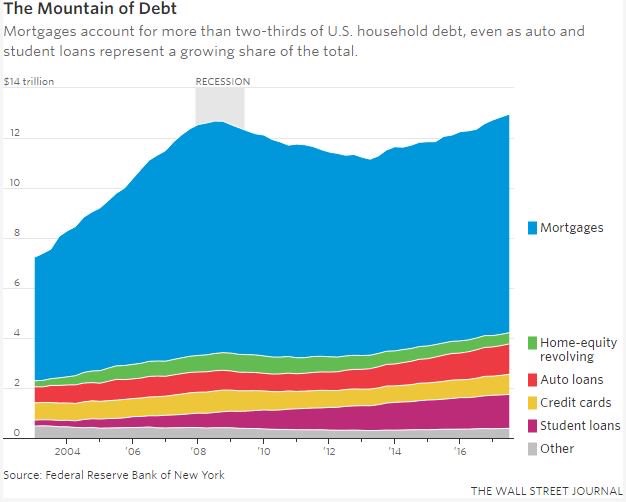
The United States current culture is best characterized by “Romantic Consumerism”, which is a type of materialism that refers to the idealization of consuming goods and services.

This value system leads to the endless pursuit and consumption of more and more products and/ or services (experiences).

I’ve been thinking about some qualitative questions:

  • Why does the USA have so much debt?
  • Why does the USA public and private debt highest compared to all developed nations?
  • Why is public and private savings the lowest in recent US history?
  • Why have real wages stagnated since 1975, while real GDP has increased 350% since then, and inequality become the highest of any developed nation?


Is this increasing debt and consumption a good thing?

When I was in college studying economics, I took some “macroeconomic policy” courses and “history of economic thought” courses that at blew my mind…

There are a number of factors at play with Romantic Consumerism, and US private debt:

  • Sociological: Keeping up with the Jones’s (Veblen) is key to understanding Romantic Consumerism
  • Psychological: we are not rational creatures, and we don’t do what’s in our best long term interest, and advertising and marketing really exploit this (Kahneman, Tversky)
  • Federal Banking: the monetary policy used to justify “growth” incentives lending, which really just helps the people with money get more money (Galbraith)
  • Lack of regulations: Lenders have more power than borrowers , and they can lend irresponsibly and fuck borrowers
  • Financialization: it used to be that lending was a capitalist enterprise, where money was used to invest in business or things that would yield returns to grow the economy, such as a business or a house or education. But now you can borrow for anything: appliances, food, lingerie, etc. “revolving credit” or CC debt has exploded… which historically was never really a big thing. (Freidman)

Financialization refers to the growth of the finance/lending industry as a % of gdp. This is not good in the long run, because lending creates money from thin air, which inflates the actual prices of things higher than their real value… this leads to economic shocks and depressions etc.

Financialization is bad for a number of reasons, but mostly because it drives inequality: lending just gets the rich richer.

How or why is it bad?

The wealthy lend to the poor, charge interest to make money, so the poor can buy things from the rich (1% own like 90% of stocks, aka Corporations) so that the rich/ corporations make more money/profit, which they then use to lend to the poor again, so the poor can buy from the rich, etc etc, round and round.

Hence you see this massive inequality since 1975 when they did away with the gold coin act and instituted fiat currency which allows for monetary policy… which directly incentives lending etc round and round

This is exactly what “trickle down economics” refers to.

Also, monetary policy (aka adjusting the money supply to modify lending behaviors, which according to the prevailing “neoclassical economic theory” used by the fed) is “supposedly” good because it stimulates consumption by increasing the money supply by lending more money.

HOWEVER, the inflation rate and the unemployment rate are causally inversely related in the short term, but NOT in the long term, as the natural rate of employment always prevails. (Friedman)

Why is this significant?

Stagnating in Real Wages

Why? Current neoclassical economic theory says “inflation” is good. Like we just said, more money supply = more lending = more consumption. If the inflation rate is 3-4% your dollars today are worth more than your dollars tomorrow. You spend your money today, and don’t save it. (Also probably why we have the lowest historical savings rates.)

How does this effect employment rate?

The higher the inflation, the more consumption, and hence more jobs. So workers can bargain for higher wages. Great. This causes a decrease in unemployment. Great. But on the long term? They have their job, but inflation is causing CPI prices to go up and up, but their wages don’t. They maintain the same. Hence stagnating wages.

But the fed doesn’t want to decrease the inflation, because they believe this stimulates lending and spending and consumption.

But the reality is this whole policy is the Primary economic driver for inequality

Monetary policy also impacts wage bargaining power. By preventing full employment, workers cannot bargain for higher wages.

Who knows if this analysis is 100% right, but these are my current intuitions.

Brand advertising

Advertising may not immediately be effective. Repetition is the key. At first, it’s unknown and foreign. But after seeing it many times in different places associated with different platforms and people, consumers are more inclined to make the purchase when the time comes.

Brand awareness is a slow and steady task. It’s about building up brand capital in the collective imagination. Videos and advertising are essential to getting people familiar and comfortable with the brand, so when they see it or hear it, and have to decide whether or not to pull the trigger, they are more inclined to rationalize because they’ve been exposed many times before, and have positive impressions.

Intelligent Design

Complexity is not a substitute for intelligent design. Just because you don’t understand something doesn’t mean you substitute god for an answer. Religious apologists need a course on physics, thermodynamics, evolution, genetics, etc etc etc.

Energy cannot be created or destroyed (First law of thermodynamics). The universe is simply energy. It was never created. Created implies a creator, and that isn’t the case. It always was, even before the big bang. Energy just changes form. We described the way this energy materializes and behaves using the discipline of physics. Physics is not truth. It’s just a description of how physical bodies behave.

So long as we are always exploring and accumulating more data (science) there will always contradictions, because new information causes us to revise our understanding. When we toss out old ideas, and adopt new ideas that possess more explanatory power and utility, we progress our understanding of the world.

What does Ray Comfort believe? In a book, the bible? Who wrote the bible. Men? Who wrote the Vedas? Dao de jing? Qur’an? Dhammapada? Qur’an? The Catholic Bible is different from the Protestant Bible; which one is correct? Who wrote those books? Men? What makes one book better than another book? Who possess the truth? Who’s God is correct?

Are men fallible? Yes. Would you rather put your faith in a book, written hundreds or thousands of years ago, by a man or even dozens of men, who supposedly heard the voice of a supernatural being?, or evidence?

What is evidence?

Evidence is data, and data is collected by our senses when we experience the world. When we study a subject, such as biology, we collect data via our senses, using direct observation with our eyes, nose, ears, or touch, or indirect observation using instruments like microscopes or mass spectrometers etc. Evidence is data that is accessible to every man, because it can be experienced and evaluated. We can say: Look at this data. Here is a particle, and this is its behavior. We can measure it and quantify it, and identify patterns, and then infer the significance of these patterns. After we formulate an inference, we test it. We start with a hypothesis, and we try to falsify it with experimentation. We subject the hypothesis to tests. If the hypothesis fails, we revise the hypothesis and do the experiment over again. If the hypothesis is upheld, we then go to other experts and show it to them. In the scientific community this is called peer review, where other experts in the field look at the methodology and results and poke holes in the hypothesis. They even try to duplicate the results. If the hypothesis is upheld under scrutiny and it cannot be falsified, then it is established as fact. Facts form the basis of theories. If enough facts are accumulated, they form the basis of our understanding of the world and its nature. “A scientific theory is a well-substantiated explanation of some aspect of the natural world, based on a body of facts that have been repeatedly confirmed through observation and experiment. Such fact-supported theories are not “guesses” but reliable accounts of the real world.” In time, some theories even become laws, because they are so reliable for explaining our world, we can even use them to make predictions.

This is science.

It is constantly wrong, and constantly updating its beliefs in light of new evidence. This is progress. It doesn’t pretend to know it all. That’s why it’s great. It always gets better.

And the alternative is what? A book? What book? your book? Ray Comfort’s book? Written by who? Lots of people? One person? Why believe them? Because they heard the voice of god? They were chosen? What about the Mormons? The the guy down the street who hears voices? Or Muhammad? What makes anyone more legitimate for writing divinely inspired texts than anyone else?

And are these books wrong? Never? They never change? They just want the world to conform to their beliefs? This sounds dark and twisted and controlling.

The people that believe in religious texts are never wrong? Or, only christians are right, but everyone else is wrong? But then, every christian has been graced with the truth, but everyone else in the world is just lost and suffering because why? God wants to punish them to hell for eternity?

But didn’t we establish that humans are fallible and wrong? They make mistakes? So then, we have to admit, there’s a good chance that a religious person’s belief in the absolute correctness of their religion is probably mistaken.

So what’s the alternative? Science. Why? Because it humbly looks for ways it can be wrong so it can add to its body of understanding and progress its knowledge and explain more things that we don’t understand.

Sociology Concepts

Define the following concepts and provide examples:

Sociology

Social psychology

Institutions

Structural functionalism/Functionalism (social structure/organization)

Structuralism (linguistic theory/semiotic analysis)

Semiotics

Legitimization

Practices, norms, rituals, customs, traditions

Roles

Role-playing

Doxa

Habitus

Culture

Enculturation vs socialization

Cultural reproduction

Ideology

Paradigm

World view

System justification

Social evolutionism

Nomos

Antimony

Marginality


Stories Manifest Reality

Stories mediate conscious experience and form the basis of reality as we know it.

This aligns with everything I’ve read and know about philosophy, psychology, sociology, anthropology, linguistics, theology, religion, and the methods of science… stories and narratives form the basis of our conscious experience; they are the hallmark of the human condition, and what separate us from all animals. 

Everything I’ve read and experienced and reflected upon confirms this.

My studies have made it more and more evident throughout the years, but the book Sapiens boldly distills broad empirical research to support it.

It’s difficult to wrap the mind around what this means exactly, and see it’s far reaching implications. It’s difficult because, our minds are embedded in narratives, embedded within stories that mediate our conscious experience. These stories or narratives operate unconsciously, like programs running on your computer, like an eye trying to examine itself without a mirror.

But they impact our ability to perceive, to engage with reality in different ways, even our ability to see and hear phenomena directly acting upon us. The stories we become conditioned to either enhance our ability to perceive and adapt and explain and engage with our world, or limit it.

We only hear what we understand.

“The limits of my language means the limits of my world.”
—Ludwig Wittgenstein

“When we change the way we look at the world, the world we look at changes.”
—Leo Tolstoy

Contemplation and reflection are the mechanisms which allow the mind to examine itself and it’s unconscious assumptions, to detach from ideas— the thoughts and feelings produced by stories— and identify inconsistencies and contradictions and paradoxes (problems) that create dissonance and discomfort and suffering (pain). Reflection is the basis of all enlightenment, and how we reconcile conflicting stories and the beliefs they produce.

Every story and narrative mediates our experience with the world. They act as a filter that organizes data and information for our senses and the faculties of our mind that we can then use to make decisions.

Every story has contradictions and inconsistencies, because no story completely explains everything about our world, because our world is always changing and evolving.

If we believe our story is absolutely “True”, we won’t revise our stories and change our beliefs. As a result, we will want to revise and change the world to conform to our narrative. The latter is incompatible with the highest realization: impermanence is the only permanence; change is the only constant.

It is the philosophers and critical thinkers duty to expose those inconsistencies and contradictions, so we can revise our stories, update our webs of belief, and provide a more comprehensive story and understanding of the world.

Our ability to choose a story relies on our understanding of the relative nature of our conscious experience. Traveling and exposure to new cultures, reading books, meeting and befriend those with different beliefs, (even taking psychedelics), all enlarge our understanding that Truth is not an absolute construct. The stories that form the basis of our beliefs all mediate our perception of Truth.

Those who share the same stories agree to the same truths, and see the same world. Those that don’t have fundamental contradictions about what is.

Stories vary in simplicity and complexity, and therefore have a spectrum of explanatory power. The stories of hard sciences may not possess the same utility as religion or Jung’s theories of mind when treating psychological illness. Likewise, the stories of religion may not possess the same utility as hard science when treating physiological illness, or solving environmental crises.

Placebo’s (stories that have no basis to the material world) have consistently been shown to be more powerful than many pharmaceutical treatments.

The only explanation is the power of stories, and the mind’s power to manifest the experience it believes in.

The basis of personal development and self-mastery lies in the understanding and acceptance that we can update and revise personal narratives and beliefs that alter our behavior and lead to desirable results.

We are not fixed, static creatures, unless we refuse to let go of limiting stories and beliefs.

It is difficult to let go of assumptions that have deep emotional attachment. Many people are unable to accept that their conscious experience is relative, that their experiences are not True, in the capital T sense. Your conscious experience is true according to your story, and anyone who shares your story.

Your feelings and thoughts are real. You cannot tell someone they are not. But it’s not the whole story. Those feelings and thoughts are not “necessarily” true. There are other ways to feel and think about the same events and people and ideas.

Your conscious experience is limited to the stories you are conditioned to believe about the world. Pain and pleasure and everything in between. And those who share your story affirm your beliefs and reinforce the conditioning of those stories, which in turn operate more pervasively as unconscious assumptions of the world, as cosmic Truth.

In this way it becomes increasingly difficult to accept the relative nature of the conscious experience, and examine personal narratives and the beliefs they produce in ways that allow for the adoption of updated stories, which stimulate growth and enlightenment and progress towards harmony and flourishing.

Because self-preservation is the highest aim and prerogative of all life, and because life requires constant adaptation to maintain equilibrium, it would seem evident that stories which allow us to revise and update themselves, to accommodate new information about the world, and enhance our explanatory power about the world, would be the best operating narrative. This is precisely the task of science and philosophy.

By examining a story’s explanatory power, we can evaluate its utility and merit, and determine if it’s good or bad, if it should be adopted or rejected.

Every group of humans possess narratives. Some are global, like religious stories, and some are local, like cultural traditions, or personal historical narratives. Some are specific to domains or subjects of thought, like the mind (psychology) or society (sociology) or the body (medicine), and some the world (geology) and life (biology), and some deal with abstractions (mathematics and physics) and methods (philosophy) for organizing experience in an intelligible way.

It’s important to realize that stories provide meaning. They guide our behaviors and provide a moral framework for action and productive social collaboration, and point us toward a worthwhile purpose to struggle and labor after.

Because there are endless stories to tell, and endless stories that exist, one may conclude a nihilistic attitude, that all is meaningless.

It is accurate to say that no story possesses inherent meaning, other than the meaning that the collective imagination gives it. But that is meaning. Realizing that there is no inherent meaning imposed by transcendental truths establishes a freedom to create stories and meaning relative to your experience, which allows you to be the hero, the protagonist, rather than a spectator caught in stories imposed by others, such as religious orthodoxy, demagogues and charismatic personalities, or brand advertising that reinforce cultural values such as consumerism.

You can create your own story, and live it out, with the peace of mind that you have a purpose as fulfilling and meaningful as any story you would have inherited.

*

Ultimately, stories (which organize our perceptions and form the basis of beliefs) manifest our conscious experience, and explain:

  • Why placebos work
  • Why self help works
  • Why brainwashing works
  • Why religious people insist on their religious experiences
  • Why people who believe in supernatural shit seem to also experience it (I don’t believe, so I will never experience it)
  • Why propaganda works
  • Why paradigm shifts occur
  • Why political parties have such divisive narratives
  • Why brands are so powerful
  • Why spiritual phenomena seems to exist for believers 

Will the Way

Where there is a will there’s a way. No one is a victim to circumstance. We can let circumstance define us, or we can define circumstance. I’m a firm believer you don’t need to have all the answers, you just need to have a goal, a vision, and know where you want to go and be, and persist with grit and grind until you get there. It’s never linear. You figure it out. Trial and error. Up and downs. But, those who refuse to compromise their vision, who refuse to be broken, will always achieve one day. Life never gets easier, you only get stronger. If we had all the answers, we would be exactly where we want. But we don’t, so we must learn. The learning process is the journey to our destination. There is no such thing as failure if you learn. Never quit. Carve out a vision, craft it and sculpt it with the powers of your mind, and make it a goal to materialize and actualize it. Make a decision to take steps every day to carve that vision into reality. Our brains doesn’t know difficulty. We either have the answers or we don’t. Time passes whether we dream big or small. Always dream big. Always. Make sure your goals and dreams scare you. Because if it doesn’t challenge you, it doesn’t change you. And if you don’t change, you don’t get better. And if you don’t get better, you’ll be exactly where you started.

Fundamental Reason for Political Divide

How can you be a reasonable, intelligent citizen, yet arrive at such ludicrous policy conclusions?

The classes I took in symbolic/ Formal Logic taught me something exceedingly valuable.

I learned about the nature of logic, its forms and methods, and the various conclusions you arrive at with arguments.

I discovered the difference between Truth, Validity, Cogency, Strength and Soundness.

Truth and falsity is a property of statements or premises.

Deductive arguments are Valid or Invalid, Sound or Unsound. An argument is valid such that it is impossible to have all true premises and a false conclusion. An argument is sound if it is valid, and all its premises are true.

Inductive arguments are Cogent or Un-cogent, Strong or Weak. An argument is cogent if it is valid, and all its premises are probably true. The argument is strong or weak according to the probability of its premises being true. (Probability is a function of statistics, or data point frequency given a sample set and hypothesis)

All this being said, what is important here is understanding that the premises themselves are composed of “facts” or “assumptions” or “beliefs” about the world. Facts are typically universally agreed upon, usually affirmed by the scientific method and a community of scientists that critique experiments.

But some premises such as assumptions and beliefs, derived from limited experience or here say, are not universally accepted and agreed upon. In this way you can have very complex, intelligent arguments that are valid, assuming you believe all your statements are true, but someone else may fundamentally disagree, because they don’t hold all your statements true.

As a christian you accept a belief about mankind that is radically different from most secularists: Man is a sinner, and inherently evil. And without God, or accepting jesus, you are evil, lost, and ignorant.

Secularists believe that man is inherently good, that all men strive for the same end, to survive and flourish and be happy, and that circumstance and trauma makes him “bad” and selfish, and love and community is at the heart of rehabilitation. Not god.

This fundamental difference in belief leads is drastically different approaches to prescribing fixes to society.

As long as you live according to the Bible, believe in God, and claim to be a Christian, you pretty much can justify a lot of behaviors in the name of God.

This explains the Trump phenomenon, and why is deplorable behaviors go unnoticed by his supporters, and are even praised. We’re all sinners and make mistakes, but we can be good, just so long as we ask God for forgiveness.

But in the eyes of Christians, if you’re a secularist, no matter how “good” you are, you will always be “bad” because you’re a sinner, and not pursuing the will of God.

In a very simple nutshell, this is how two groups of seemingly intelligent people arrive at such dramatically disparate and even competing prescriptions for society.


Reading with Reason

I possess a desire to derive more from reading and the many books I consume.

I’ve been contemplating ways to get more out of each book. I have many books, many unread books. But every book has a purpose. I purchase books because there’s some facet of ignorance in my storehouse of knowledge that needs to be filled in. So I buy these books, and they accumulate on shelves. I pick through them, read a book, and discover references to other books, and this is how the majority of my library grows and reading is guided.

However, many times I forget the exact reasons I was inspired to read the book in the first place.

As a result, I want to write a list of reasons on a sticky note of why this book needs to be read, and attach it behind the front cover. This way, whenever I pick up the book, I can see exactly why this book is important and relevant, its significance, how it fits into my understanding, and the history of knowledge and understanding and discovery.

In addition, I would like to write blog posts summarizing every book I read, maybe just hashing out thoughts as I read. Which should force me to read one book at a time, because at my current rate of 3-4 books, it’s far too much to write every day. It’ll keep my focus and allow me to get more out of my studies.

I’m currently reading 3 books:

  1. Sapiens: A Brief History of Mankind by Yuval Harari
  2. Ideas by Husserl
  3. An Invitation to Reflexive Sociology by Bourdieu and Wacquant